

Few IRS collection actions feel as serious as the possibility of losing your home, car, bank funds, or other property. While the IRS has broad authority to levy assets when taxes remain unpaid, that authority is subject to specific legal rules and exemptions. Some assets are easier for the IRS to reach than others, and a primary residence, retirement account, or essential household property may receive additional protection.
Understanding IRS asset seizure can make the situation much less uncertain. This guide explains how IRS levies work, which assets are most vulnerable, what property is protected, and the legal safeguards that apply before the IRS can take certain assets. It also covers the resolution options that may help you stop a levy before it becomes an actual seizure.
Key Takeaways
- The IRS can legally levy bank accounts, wages, investment accounts, vehicles, and real estate under its statutory levy authority.
- What can the IRS take depends heavily on the type of asset. Liquid accounts are targeted first; a primary residence requires a federal court order in most cases.
- IRS can take your house rarely, and only after significant legal hurdles, including judicial approval for a principal residence.
- Social Security benefits can be levied, but the automated program caps the amount at 15% of each payment.
- Certain property is legally protected from seizure under federal exemption rules, regardless of the state a taxpayer lives in.
- An installment agreement, an Offer in Compromise, or Currently Not Collectible status can stop or prevent a seizure in nearly every case.
How the IRS’s Seizure Power Works
Before looking at specific assets, it helps to understand the legal foundation behind IRS collection power and how a levy differs from the lien most taxpayers hear about first.
The levy authority under IRC 6331, and why it’s so broad
Section 6331[a] of the Internal Revenue Code gives the IRS authority to levy a taxpayer’s property or rights to property to satisfy unpaid tax debt. This authority extends to bank accounts, wages, investment and brokerage accounts, accounts receivable, vehicles, and real estate. In other words, property the IRS can seize includes both financial assets and physical property, subject to the applicable legal requirements.
Before a levy can happen, the IRS must generally send a notice of intent to levy, along with a Collection Due Process notice explaining the taxpayer’s right to a hearing. Ignoring that notice is what allows the IRS to move from threat to action.
Levy vs. lien: a claim on property vs. taking it
A tax lien and a tax levy sound similar but work differently. A lien is a legal claim against property, essentially a marker that tells other creditors the IRS has a stake, but it does not remove property from the taxpayer’s possession.
A levy is the actual seizure. It converts that claim into action, whether that means freezing a bank account, garnishing wages, or taking title to a vehicle or piece of real estate.
Most taxpayers first encounter this process through routine notices rather than a lien filing. Here is what that first notice usually looks like in practice:
Read More: CP14 Notice: What Your First IRS Bill Really Means and What to Do Next
What the IRS Goes After First: Liquid Assets
Liquid assets are the path of least resistance for the IRS. They are easier to value and faster to collect than real estate or physical property.
Bank accounts and the 21-day hold before funds are sent
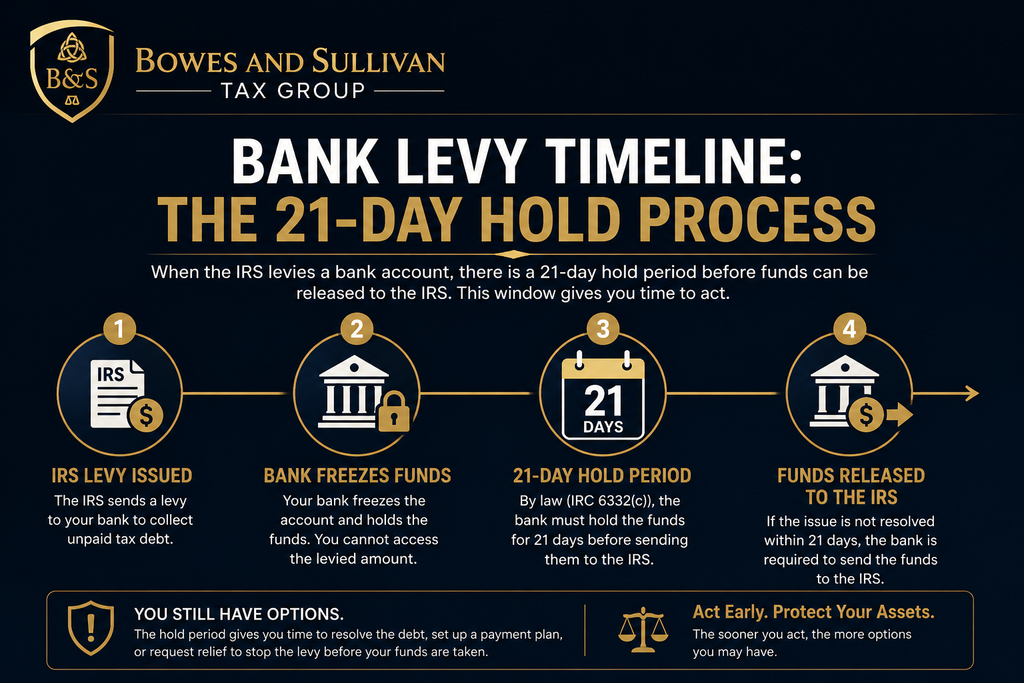
When the IRS levies a bank account, the bank does not send the funds immediately. Under IRC 6332(c)[b], the bank holds the frozen funds for 21 days before releasing them to the IRS. This means an IRS seize bank account action does not result in an immediate transfer of funds.
This window exists specifically to give the taxpayer time to resolve the issue, whether through a hardship claim, a payment arrangement, or a dispute over the amount owed. Once the 21 days pass without resolution, the bank is legally required to send the funds.
Wages, and how much of your paycheck the IRS can take
Unlike a one-time bank levy, an IRS wage garnishment is continuous. It keeps taking a portion of every paycheck until the debt is resolved or released.
The law protects a minimum amount of income from garnishment, based on filing status and the number of dependents claimed, with the exempt figure adjusted annually for inflation. Everything above that protected floor is generally available to the levy.
Investment and brokerage accounts
Retirement accounts get special protection, discussed below, but ordinary investment and brokerage accounts do not receive the same treatment. The IRS can levy these accounts much like a bank account, reaching cash balances and, in some cases, forcing the liquidation of securities to satisfy the debt.
Can the IRS Take Your House?
This is the question that generates the most anxiety, and the one where the gap between fear and reality is widest.
Why a primary residence requires a federal court order
A principal residence carries real legal protection. If the total levy amount is $5,000 or less, the home is automatically exempt under IRC 6334(a)(13)(A)[c], so small balances never put a house at risk.
For larger balances, seizing a primary residence requires written approval from a federal district court judge or magistrate under IRC 6334(e)[d]. The IRS must demonstrate that the liability is actually owed, that proper procedures were followed, and that no reasonable alternative exists for collecting the debt.
This judicial requirement makes primary residence seizures rare in practice. The IRS treats them as a last resort, generally reserved for cases involving large balances and a taxpayer who has ignored every other opportunity to resolve the debt.
| A federal district court judge or magistrate must approve any seizure of a taxpayer’s principal residence for a balance above $5,000. This judicial review step is required by law under IRC 6334(e) and cannot be waived by the IRS on its own authority. |
How other real estate, rentals, land, vacation homes, is different
A primary residence is the exception, not the rule. Rental property, vacant land, and vacation homes do not carry the same judicial approval requirement, and the IRS can pursue them with considerably fewer hurdles.
Business assets sit in a middle category. Seizing them generally requires Area Director approval under IRC 6334(e)(2), which adds a layer of internal review, but not the same court process required for a primary home.
Your Retirement and Social Security
Retirement income raises its own set of questions, since these funds often represent a taxpayer’s only source of support later in life.
When the IRS can reach a retirement account
Retirement accounts, including 401(k) plans and IRAs, are legally reachable by an IRS levy. There is no blanket exemption protecting them the way there is for certain household items.
In practice, IRS policy discourages levying retirement accounts except in cases involving “flagrant” noncompliance, such as a long pattern of ignored notices or deliberate evasion. Most cases are resolved through other means before a retirement account levy becomes necessary.
The 15% cap on a Social Security levy
Social Security retirement, survivor, and disability benefits can be reached through the Federal Payment Levy Program (FPLP), an automated system authorized under IRC 6331(h)[e]. Under the automated program, the IRS can levy up to 15% of each monthly payment, and that cap holds regardless of how large or small the benefit is, according to the Social Security Administration[f].
Supplemental Security Income (SSI) is not reachable through the FPLP. A manual levy, initiated by an IRS agent rather than the automated system, can exceed the 15% figure in certain circumstances, though this is far less common than the standard automated levy.
| Supplemental Security Income (SSI) can never be levied by the IRS, under any circumstances. Standard Social Security retirement, survivor, and disability benefits can be levied, but the automated program is capped at 15% of each monthly payment, regardless of the benefit amount. |
What the IRS Cannot Take: Exempt Property
Federal law carves out specific categories of property that stay protected regardless of the balance owed, and assets exempt from IRS levy rarely get discussed alongside the more dramatic seizure stories.
The everyday items the law protects under IRC 6334
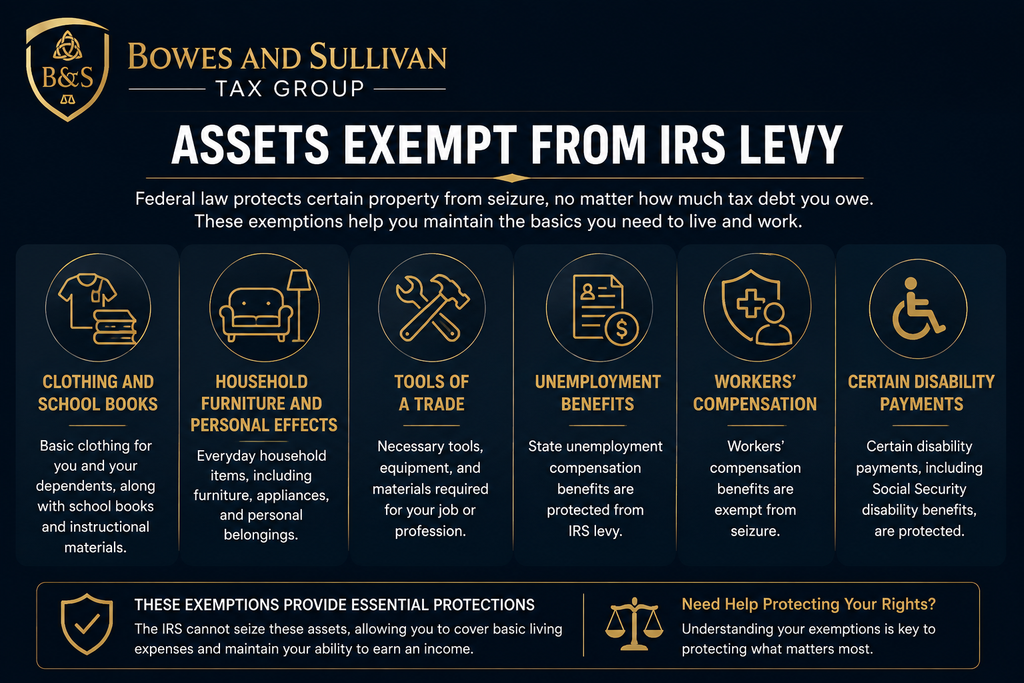
Section 6334 of the Internal Revenue Code lists categories of property that are exempt from levy. The dollar limits on several categories adjust for inflation each year.
| Exempt category | 2026 limit or rule |
| Wearing apparel and school books | No dollar limit; necessary items only |
| Household furniture, fuel, provisions, and personal effects | Up to $11,980 in value |
| Books and tools of a trade or business | Up to $5,990 in value |
| Unemployment benefits | Fully exempt |
| Workers’ compensation benefits | Fully exempt |
| Certain service-connected disability payments | Fully exempt |
| Minimum wage exemption amount | Based on a $5,300 base figure, adjusted by filing status and dependents |
| Primary residence in small-balance cases | Exempt if the levy is $5,000 or less |
These protections exist automatically. A taxpayer does not need to petition for them, though valuation disputes can arise, particularly for tools of a trade or business equipment near the exemption limit.
Why state exemptions don’t stop a federal levy
Many taxpayers assume that state homestead laws or state-level asset protections shield property from IRS collection. They do not.
Federal tax levies override state homestead exemptions and state garnishment protections. No state bank account, and no state-protected homestead, is beyond the reach of a federal levy once the IRS has the legal authority to act.
How to Stop or Prevent a Seizure
The good news buried in all of this is that seizures are rarely inevitable. Nearly every case that ends in a levy had earlier opportunities to resolve the debt first.
Installment agreements, Offers in Compromise, and hardship status
Three main paths generally stop or prevent collection action:
- Installment agreements set up a structured monthly payment plan, which brings the account into active resolution status and typically halts new levy action.
- An offer in compromise allows a taxpayer to settle the debt for less than the full amount owed, when the IRS agrees the full balance cannot reasonably be collected.
- Currently Not Collectible status, sometimes called the IRS hardship program, pauses collection entirely when paying would create genuine financial hardship, though interest and penalties continue to accrue in the background.
Each option fits a different financial picture, and choosing the right one often determines how quickly a levy threat resolves. Here is a closer look at how hardship status specifically works and who tends to qualify:
Read More: IRS Currently Not Collectible Status: What CNC Means and How to Qualify
An Advisor’s Take: Why Seizures Are Almost Always Preventable
Seizure cases that reach the level of an actual bank levy, wage garnishment, or property action are rarely a surprise to the IRS system. They generally follow months of unanswered notices.
Acting before the levy, not after
The window between a Notice of Intent to Levy and the actual levy is the most valuable time a taxpayer has. Responding during that window, whether by requesting a Collection Due Process hearing, submitting financial documentation, or entering a payment plan, stops the vast majority of seizures before they happen.
| A Final Notice of Intent to Levy gives a taxpayer only 30 days to request a Collection Due Process hearing before the IRS can proceed with a levy. Missing this window removes the strongest tool available for pausing collection while a resolution is worked out. |
Bowes and Sullivan Tax Group is led by a Certified Tax Resolution Specialist and a former IRS Revenue Officer with decades of combined collection experience. The firm works with taxpayers nationwide to release active levies, negotiate IRS tax debt relief arrangements, and resolve tax lien issues before they escalate into forced collection.
For taxpayers with a frozen account, timing matters more than almost anything else in getting funds released. Bowes and Sullivan can also help taxpayers address tax lien issues and determine the best path to resolve their outstanding IRS debt.
Read More: Bank Levy Release: What Helps, What Hurts, And Timelines
Protect Your Assets Before the IRS Levies
An IRS seizure can be serious, but it is not usually the first step in the collection process. The IRS can levy bank accounts, wages, investment accounts, vehicles, and certain real estate, while federal law provides specific exemptions and additional protections for certain assets, including a primary residence. Acting before a levy is issued can give you more opportunities to resolve the underlying tax debt.
Bowes and Sullivan Tax Group helps taxpayers address IRS collection issues before they escalate into forced asset seizures. The firm works with taxpayers nationwide to release active levies, negotiate IRS tax debt relief arrangements, and address tax lien issues. Its team includes a Certified Tax Resolution Specialist and a former IRS Revenue Officer with decades of combined collection experience.
If you have received a Notice of Intent to Levy, have a frozen bank account, or are already facing wage garnishment, getting help early can make a significant difference. Contact Bowes and Sullivan for a free consultation to review your situation and determine the best path forward.
FAQs
Can the IRS really take my house?
Rarely, and only after significant legal steps. If the levy amount is $5,000 or less, the home is automatically exempt. For larger balances, the IRS must obtain written approval from a federal district court judge, a process reserved for a small number of the most serious cases.
How much of my paycheck can the IRS garnish?
The IRS can garnish wages beyond a protected minimum amount, which depends on filing status and the number of dependents claimed. Unlike most creditor garnishments, the IRS is not limited to a fixed percentage of income.
Can the IRS take my retirement account?
Yes, retirement accounts are legally reachable by a levy, but IRS policy generally avoids them except in cases of flagrant noncompliance. Social Security benefits face a separate rule: the automated levy program is capped at 15% of each monthly payment.
What property is exempt from an IRS levy?
Federal law protects necessary clothing and school books, household furniture and personal effects up to a set dollar value, tools of a trade up to a set dollar value, unemployment and workers’ compensation benefits, and a minimum amount of wages. These exemptions apply regardless of the state a taxpayer lives in.
How do I stop an IRS seizure?
An installment agreement, an Offer in Compromise, or Currently Not Collectible status can each stop or prevent a seizure, depending on the taxpayer’s financial situation. Acting during the notice period, before a levy is actually issued, gives taxpayers the most options.