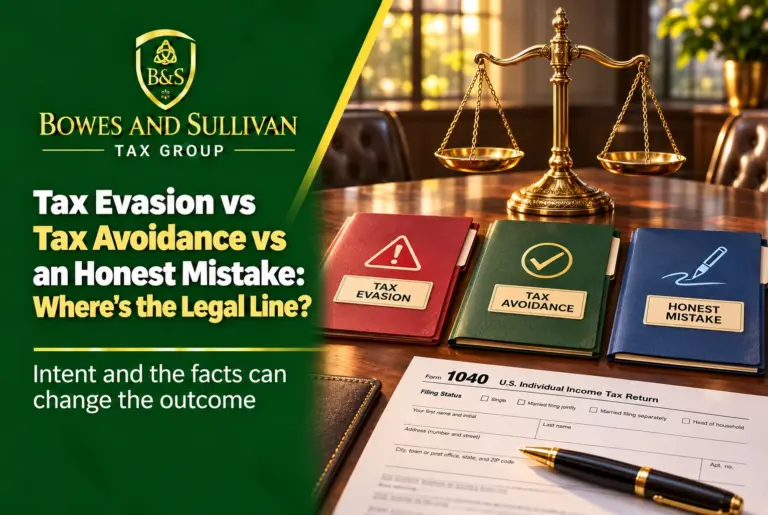
Most people who worry about tax errors haven’t committed a crime; they’ve made a mistake or used legal tax benefits as intended. Terms like evasion, avoidance, and fraud are often confused, leading ordinary taxpayers to worry about legal action while ignoring real risks.
Tax evasion vs. tax avoidance isn’t really a debate. Tax avoidance legally lowers tax liability, whereas tax evasion intentionally breaks the law to avoid paying. An honest mistake may result in penalties or additional taxes, but it is not automatically a crime.
Key Takeaways
- Tax avoidance (deductions, credits, structuring) is legal. The Supreme Court confirmed the right to minimize taxes in Gregory v. Helvering (1935).
- Tax evasion is a felony under IRC § 7201, punishable by up to 5 years in prison and a fine of up to $100,000 for an individual. It requires proof of a tax due, an affirmative act to conceal it, and willfulness.
- An honest mistake is a civil matter, usually a 20% accuracy penalty at most, and often avoidable with reasonable cause.
- Willfulness, not how aggressive a position looks, is what separates a crime from a mistake.
- Failing to file without concealment is a misdemeanor (IRC § 7203), not felony evasion.
Three Very Different Things People Confuse
Avoidance, evasion, and an honest error get lumped together because all three can result in paying less tax than someone expected. But they are very different at their core.
Avoidance, evasion, and honest error, and why the difference is huge
- Tax avoidance is the legal use of deductions, credits, and structuring to reduce what you owe.
- Tax evasion is a federal felony, and to prove it, the government has to show you knew you owed money and took deliberate steps to hide it.
- An honest mistake is neither of those. It’s an error made without intent to deceive, and the code treats it as a civil issue, not a criminal one.
Tax Avoidance: Legal, and Your Right
Cutting your tax bill through legal means isn’t an issue. It’s a designed feature of how the system works, and taxpayers are entitled to use it.
Deductions, credits, and structuring within the rules
Standard tax avoidance strategies include contributing to retirement accounts, taking mortgage interest deductions, timing asset sales, or selecting an optimal business structure. These methods rely on transparent, accurate reporting under intentional tax code provisions designed to incentivize specific financial behaviors.
What the courts have said about arranging your affairs to pay less
In Gregory v. Helvering (1935), the Court confirmed that a taxpayer can arrange their affairs to keep taxes as low as possible, and that nobody owes the government a cent more than the law requires.
However, the Court rejected the transaction because it lacked a genuine purpose beyond dodging taxes. That remains the standard. Legitimate business or financial deductions count as tax avoidance, whereas artificial transactions designed to conceal income can constitute tax evasion.
| Having a tax-saving motive doesn’t disqualify a transaction from being legal. The test is whether there’s also a genuine business or economic purpose behind it, not tax savings alone. |
Tax Evasion: A Federal Felony
Cross from avoidance into evasion, and you’re in a different legal category entirely. This isn’t a dispute over numbers anymore. It’s a crime, and the government has a specific bar to clear before it can prosecute one.
The penalties under IRC 7201: prison, fines, and prosecution costs
Tax evasion is illegal. Under 26 U.S.C. § 7201, intentionally evading taxes is a felony punishable by up to five years in prison and fines up to $100,000 for individuals ($500,000 for corporations). Under the Criminal Fines Enforcement Act, individual fines can reach $250,000, plus the costs of prosecution.
The three elements the government must prove
Owing money and not paying it isn’t enough for a felony conviction. Prosecutors need three things: a tax that was actually due, an affirmative act to evade it, and willfulness. Drop any one of those and the case doesn’t hold up. Criminal tax cases target people who took deliberate action to keep the IRS in the dark, not people who simply fell behind.
The affirmative acts that turn non-payment into evasion
This requirement traces back to Spies v. United States (1943), where the Supreme Court ruled that failing to pay, on its own, isn’t enough to support a felony evasion charge. Something more has to happen, some positive act aimed at concealment. Think a second set of books, income parked in someone else’s name, destroyed records, or a return with numbers the filer knew were false. A taxpayer who just doesn’t file, or files honestly and can’t cover the bill, hasn’t crossed that line, and typically ends up under a different, far less severe statute.
| Not filing at all, with no concealment, is generally a misdemeanor under IRC § 7203, up to a year in jail per year unfiled. Add an affirmative act to hide income, and it becomes felony evasion under § 7201, up to five years. |
The Honest Mistake: Where Most Taxpayers Actually Are
Typical honest mistakes include math errors, miscalculating eligible deductions, entering an incorrect Social Security number, or forgetting to report income from a stray 1099 form.
When processing returns, the IRS generally identifies these discrepancies through automated matching systems (such as the Automated Underreporter program) or routine correspondence audits. Instead of initiating a criminal investigation, the IRS usually issues an information letter or notice proposing adjustments to the tax owed, along with applicable interest or minor civil penalties, allowing taxpayers to clarify or correct the issue.
Accuracy penalties and reasonable-cause relief, not handcuffs
The realistic consequence is the accuracy-related penalty under IRC § 6662, generally 20% of the underpayment tied to negligence or a substantial understatement.
Even that isn’t automatic. Under IRC § 6664, a taxpayer can sidestep it by showing reasonable cause and good faith, relying on accurate third-party information, say, or making a genuine, documented effort to get the numbers right.
Read More: IRS Penalty Abatement: Reduce or Remove IRS Penalties
How amending a return signals good faith
If you catch an error after filing, amend the return. It’s one of the clearest ways to show the IRS the original mistake wasn’t an attempt to deceive anyone, and that once you spotted it, you fixed it on your own. Taxpayers who self-correct get treated very differently than taxpayers who only come clean after an audit letter shows up.
Willfulness: The Line Between Them
Everything above hinges on one legal concept. Willfulness is what separates an honest error from a federal crime, and proving or disproving it is where most of these cases actually get won and lost.
Why a genuine good-faith belief can defeat a criminal charge
In Cheek v. United States (1991), the Supreme Court defined willfulness as a voluntary, intentional violation of a known legal duty. The government has to prove you knew what the law required and chose to break it anyway. The Court went a step further: a genuine, good-faith belief that you were complying can defeat a willfulness charge, even if that belief turns out to be unreasonable. So two people can make the identical error on a return, and only one is at legal risk, purely based on what they believed and why.
| Your belief doesn’t have to be reasonable to count under Cheek v. United States; it has to be genuine. That’s a lower bar than most taxpayers assume, and it’s part of why willfulness cases are so fact-dependent. |
The Civil Middle Ground: Fraud and Negligence Penalties
Between an honest mistake and a criminal conviction, there’s a civil middle ground where the IRS can hit taxpayers hard financially without ever filing a criminal charge.
The 75% civil fraud penalty vs. the 20% accuracy penalty
If the IRS can show intentional wrongdoing, even outside a criminal case, it can assess a civil fraud penalty under IRC § 6663 equal to 75% of the underpayment. Compare that to the 20% accuracy penalty for ordinary negligence, and the gap is enormous.
A taxpayer facing a fraud penalty is usually already deep into a dispute, which is often when our help with back taxes team gets pulled in, working to negotiate that claim down before it grows further.
Read More: Professional Back Taxes Help & Resolution
An Advisor’s Take: Aggressive Planning Isn’t a Crime, Hiding Is
Taxpayers get nervous about aggressive strategies because “aggressive” sounds risky by definition. It isn’t, legally speaking. The actual test has nothing to do with boldness and everything to do with disclosure.
When to get professional advice before a position becomes a problem
An aggressive position can be entirely defensible if it’s disclosed honestly and grounded in a reasonable reading of the law. What turns a position into a problem is concealment: hiding facts, falsifying documents, or taking a deduction you know doesn’t apply and hoping nobody looks.
When a position is genuinely uncertain, getting advice before filing and disclosing it on the return is what keeps you on the legal side. We generally tell clients who come to us for IRS tax debt relief to deal with uncertain positions before an audit forces the issue, not after.
Read More: Tax Debt Relief Options: How to Settle and Pay IRS Debt
Get Your Tax Line Straight Before the IRS Draws It for You
Smart planning, an honest error, and a criminal case are separated by intent and disclosure, not by how much money ended up in your pocket. But if you’ve gotten an audit notice, a letter that mentions fraud, or you’re just unsure whether a position from a few years back was too aggressive, that’s worth sorting out at the earliest.
At Bowes and Sullivan, we help taxpayers figure out exactly where they stand in their tax positions, whether that means fixing a mistake, defending a legitimate position, or sitting down with the IRS directly.
Contact us for a consultation and get a straight answer before it turns into a bigger problem.
FAQs
Yes. Deductions, credits, and legitimate structuring to lower your tax bill are legal, and courts have upheld that right since Gregory v. Helvering in 1935. The line gets crossed only when a transaction exists purely to disguise income or expenses, with no real purpose behind it.
Evasion under IRC § 7201 is criminal, provable beyond a reasonable doubt, and can mean prison. Civil fraud under IRC § 6663 is a 75% financial penalty the IRS can assess without a criminal conviction at all. They can overlap in the same case, but they run through different processes with different burdens of proof.
No. Criminal prosecution needs proof of willfulness, meaning the government has to show you knew about a duty and intentionally broke it. A mistake, by definition, has no intent behind it. Worst case, you’re looking at a civil penalty, and even that can often be avoided with reasonable cause.
Not automatically. Failing to file or pay, with no affirmative act to conceal income, is usually charged as a misdemeanor under IRC § 7203, up to a year in jail and a fine per year, not the felony under IRC § 7201. Filing a return you know is false is its own separate felony under IRC § 7206.
Amend the return first, if the error hasn’t already surfaced with the IRS. A voluntary correction goes a long way toward showing good faith. If you’ve already gotten a notice, or you’re not sure whether this is a simple mistake or something more serious, our tax relief specialists can look at it before you respond, since how you frame things in that first reply to the IRS tends to shape everything that follows.