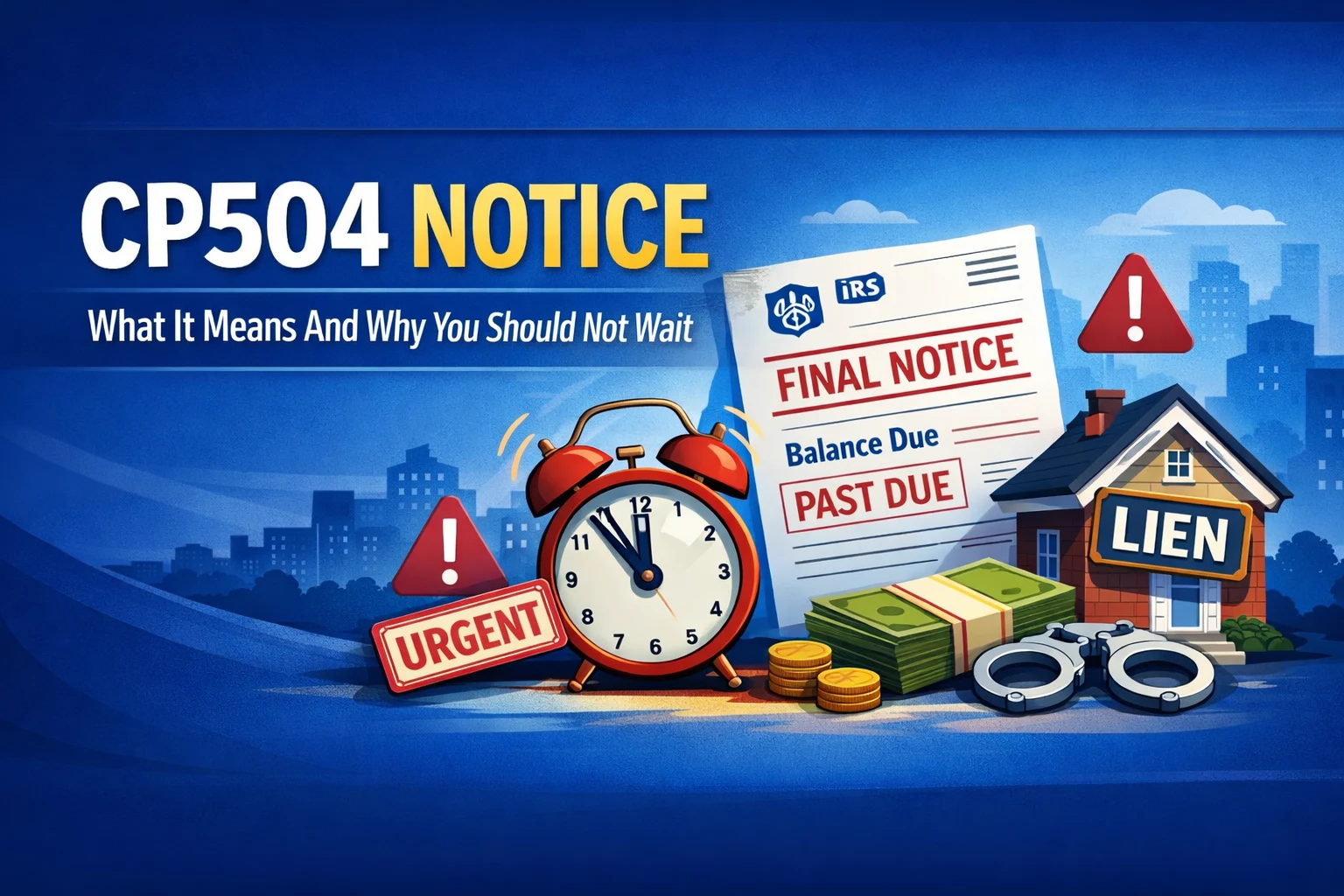
A CP504 notice raises concerns for a reason. This notice signals that something has changed in your tax account, and for some taxpayers, it becomes part of a chain of events that can affect enforcement and even passport eligibility, including situations involving seriously delinquent tax debt and passport restrictions.
This blog post explains what that notice means and how it connects to levy authority, Section 7345, and travel restrictions, so you can see where you stand and decide what steps you need to take.
Understanding The CP504 Notice Of Intent To Levy
The CP504 is an official “Notice of Intent to Levy” under Internal Revenue Code Section 6331(d). By the time you receive this notice, the IRS has usually already sent earlier balance-due letters, such as CP14 (the first bill), CP501, and CP503. Those earlier notices request payment and give you opportunities to resolve the debt voluntarily.
If the balance remains unpaid after those letters, the IRS moves to CP504. At this stage, it is no longer just asking for payment. It is a warning that it may begin using the levy authority to collect what you owe. That can include taking funds from your state tax refund now and moving closer to levies on bank accounts or wages if the issue continues.
The notice will show:
- The total amount you owe, including tax, interest, and penalties.
- A due date is usually about 30 days from the date on the letter.
- Warnings that the IRS may levy your state tax refund and may file a federal tax lien if you do not act.
Ignoring this notice can lead to real financial harm, so it’s best to treat it as urgent.
Why the CP504 Notice is considered a “Final Notice”
The CP504 is often called a “final notice” because it comes after several earlier bills and demand letters. By the time you see this notice, the IRS has already given you chances to pay or set up a plan; now it is preparing to take enforcement action.
Under the law, the IRS must send this notice at least 30 days before it can levy most of your property, which is why the CP504 is both a warning and a legal requirement. That 30‑day window is your last clear chance to stop a levy and avoid more serious consequences, including passport problems.
The 30-day window: what happens if you miss the deadline
If you do nothing within the 30‑day window, the IRS can:
- Take your state tax refund and apply it directly to your federal tax debt.
- File a federal tax lien against your property, which can show up on your credit report and make it harder to sell or refinance.
- Move on to levy wages, bank accounts, or other assets in later steps.
Missing the deadline doesn’t mean you’re out of options, but it does mean the IRS will treat your account as active enforcement, not just a past‑due bill. Interest and penalties will keep growing, so the total amount you owe will get larger over time. Acting sooner, even if you can’t pay everything, is almost always better than waiting.
How Your Tax Debt Can Ground Your Travel
Your federal tax debt can affect your passport if it qualifies as “seriously delinquent tax debt” under federal law. This consequence is tied directly to the enforcement status of the debt, not simply the fact that you have an unpaid balance. In other words, it is not just about owing money; it is about how the IRS is treating that debt and whether certain legal conditions have been met.
The 2026 Threshold and Required Enforcement Action
For 2026, a tax debt is considered “seriously delinquent” when the total assessed and legally enforceable balance exceeds approximately $66,000. This figure includes the original tax, penalties, and interest, and it is adjusted annually for inflation.
Exceeding the dollar amount alone is not sufficient. The IRS must also have taken formal collection action before certification can occur. That typically means:
- A Notice of Federal Tax Lien has been filed, or
- A levy has been issued
At the same time, certification does not apply if the account is protected by certain statutory exceptions, including:
- An approved installment agreement
- A pending Offer in Compromise
- Bankruptcy proceedings
- Innocent spouse relief
- Currently Not Collectible (CNC) status
Only when the balance exceeds the threshold and enforcement action is active, without a qualifying exception, can the IRS certify the debt to the State Department.
Certification Under Section 7345
Section 7345 of the Internal Revenue Code authorizes the IRS to certify seriously delinquent tax debt to the U.S. State Department.
When the IRS certifies the debt:
- It formally reports the account to the State Department
- It issues Notice CP508C to the taxpayer
Certification does not cancel a passport immediately. It activates the State Department’s authority to deny passport services while the certification remains in effect. The passport itself is not automatically taken away; instead, the rules around issuing or renewing it are triggered.
Passport Denied? The Certification Process Explained
Once certification is active, the State Department reviews passport applications against the IRS certification record. It checks whether the applicant’s name and identifying information match an account that has been reported as seriously delinquent.
If certification is unresolved, the State Department may:
- Deny a new passport application
- Refuse to renew an existing passport
- In limited situations, revoke or restrict a current passport
If an application is already pending, it is often placed on hold for approximately 90 days to allow time to resolve the tax debt. During that period, the State Department is essentially waiting to see whether the IRS updates the certification status.
What Notice CP508C Means
Notice CP508C confirms that your tax debt has been certified as seriously delinquent and reported to the State Department.
The notice identifies the certified amount and explains your right to challenge an incorrect certification. It does not revoke your passport by itself, but it signals that passport restrictions may occur unless the debt is resolved. It is, in effect, a formal notice that the IRS has moved the account into the certification phase.
How Passport Denial or Revocation Is Implemented
Passport denial generally occurs when you apply for a new passport or renewal while certification is active, which is how passport-denied tax debt situations typically arise under Section 7345. In those cases, the State Department sees the IRS certification and applies its rules accordingly.
Revocation of an existing passport is less common but legally permitted. In some situations, a passport may be restricted to return travel only, meaning you can use it to come back into the United States but not to leave again.
International travel is restricted until the IRS reverses certification and issues Notice CP508R. Once that happens, the State Department can move forward with your passport application or renewal. Domestic travel within the United States is not affected by IRS tax‑debt certification.
How To Stop Or Reverse Passport Certification
Passport certification does not remain permanent if the underlying tax issue is properly addressed. If the conditions that led to certification are corrected, the IRS is required to reverse it. The IRS must reverse certification once the account no longer meets the statutory definition for seriously delinquent tax debt.
Certification can be reversed when:
- The debt is fully paid
- The account enters an approved resolution status
- The IRS determines that certification was issued in error
- A qualifying legal exception applies
Once the IRS confirms that the account is eligible for reversal, it updates its system and formally notifies the State Department. That update is what allows the passport‑related flag to be removed.
Setting up an installment agreement to pause enforcement
An approved installment agreement can prevent or reverse certification because it places the account into an authorized payment status and may function as an installment agreement to avoid passport denial while the plan remains active.
When the IRS formally accepts a payment plan, and you remain current on the required payments:
- The account is no longer treated as actively delinquent for certification purposes
- Ongoing enforcement generally pauses
The IRS must process and approve the agreement before certification is reversed. Simply submitting a request or starting to make payments is not enough; the plan has to be officially accepted and active in the IRS system.
Reverse passport certification: The path to receiving Notice CP508R
Notice CP508R is the formal confirmation that certification has been reversed. It is the IRS’s way of telling you that the passport‑related flag has been removed.
This notice is issued after the IRS determines that:
- The debt has been satisfied, or
- The account qualifies under an approved resolution status, or
- Certification was incorrect
Once the reversal is processed, the IRS notifies the State Department. Passport restrictions remain in effect until that notification is completed and the State Department updates its records.
Exemptions To Passport Revocation
Section 7345 does not apply to every taxpayer whose balance exceeds the threshold. The law provides specific situations where passport certification is not allowed or must be reversed. These protections apply when the account is in a legally recognized status that pauses or restricts collection. In those cases, the IRS is not supposed to move forward with certification, or it must take it back if it was done by mistake.
Bankruptcy, identity theft, and “Currently Not Collectible” status
Certain legal protections can stop passport certification because they limit the IRS’s ability to collect. In other words, when the law or the IRS itself restricts enforcement, that same restriction usually applies to passport‑related steps as well.
This includes situations such as:
- Active bankruptcy, where collection activity is legally paused under federal law
- Tax‑related identity theft, when the IRS freezes enforcement while correcting the account
- Currently Not Collectible (CNC) status, where the IRS determines you do not have the financial ability to pay
In each of these cases, enforcement is restricted. Since passport certification depends on an active collection authority, it should not move forward while one of these protections is in place.
Pending Offer in Compromise or innocent spouse relief
Certain pending tax debt relief requests also prevent certification. If you have:
- A timely filed Offer in Compromise under review
- An active innocent spouse relief claim
- A pending Collection Due Process hearing
The IRS cannot treat the debt as eligible for certification during that review period. While those requests are properly filed and under active consideration, the law generally blocks or pauses the certification process.
These protections apply only while the request is properly filed and under active consideration. If the request is denied, withdrawn, or otherwise closed, the IRS may then reconsider whether the debt qualifies for certification, assuming all other conditions are met.
Also Read → Can You Get a Passport If You Owe Back Taxes?
What To Do If You Have Imminent International Travel
If you have international travel scheduled and receive a CP508C or a CP504 while your balance exceeds the certification threshold, it is important to act immediately. The closer you get to your travel date, the more urgent it becomes to address the issue.
Call the IRS using the number listed on your notice and explain that you have urgent travel plans. Let them know your trip is coming up soon and ask whether they can give your case an expedited review. You can also ask specifically about the status of any passport certification and what you need to do to get it reversed.
To resolve the issue, you must bring your account into an approved status. That usually means:
- Paying the balance in full
- Setting up an approved installment agreement
- Showing that the certification was issued in error
If you cannot resolve the matter directly with the IRS and your travel date is approaching, you may contact the Bowes & Sullivan Tax Group for assistance. They can help move things along when there is a clear hardship, such as an upcoming trip. You can also check your passport status through the National Passport Information Center to see whether your application or renewal is being held.
Once the IRS updates your account, it will notify the State Department. Reversal typically occurs within about 30 days, though expedited cases may move faster if the IRS agrees that there is a genuine need to act quickly.
Paying the Debt Below the Threshold Is Not Enough
Lowering your balance below the annual threshold does not automatically restore your passport eligibility. Even if the amount you owe drops under the limit, that by itself does not erase the certification that has already been made. Once the IRS has certified a debt under Section 7345, reversal requires formal administrative action, not just a change in the dollar amount.
The IRS must:
- Confirm the account no longer meets the statutory definition
- Update its certification records
- Issue Notice CP508R
- Notify the U.S. State Department
Until that process is completed, passport restrictions may remain in place, regardless of partial payment. In other words, paying down the debt is an important step, but it is not the final step; that is, the IRS has to complete its internal steps and send the right notices before the State Department can lift the restriction.
Get Formal Resolution of Passport Certification With Bowes & Sullivan
This is where structured representation becomes important. Bowes & Sullivan Tax Group does more than calculate balances. We review lien and levy status, evaluate whether certification was proper, identify applicable statutory exceptions, and communicate directly with the IRS units responsible for certification and reversal.If your passport status may be affected by tax debt, contact our tax relief specialists to review your certification status and take corrective action where necessary.
FAQs
Q1: What is the 2026 threshold for seriously delinquent tax debt?
For 2026, the threshold is approximately $66,000. This amount includes assessed tax, penalties, and interest, and it is adjusted annually for inflation. However, exceeding the threshold alone is not enough. The IRS must also have filed a federal tax lien or issued a levy before a debt can be certified for passport restriction under Section 7345.
Q2: Does the CP504 notice mean my passport is already revoked?
No. A CP504 is a Notice of IRS Intent to Levy. It warns of potential enforcement action, but it does not affect your passport directly. Passport issues arise only if the IRS later certifies the debt as seriously delinquent and sends Notice CP508C. Certification is a separate administrative step.
Q3: Can I get a passport if I am on an IRS installment agreement?
In most cases, yes. An approved installment agreement places your account into a recognized resolution status, which prevents or reverses certification. The key is that the agreement must be formally accepted by the IRS, and you must remain current on payments.
Q4: How long does it take the IRS to reverse a passport certification?
After the IRS determines that the debt no longer qualifies for certification, whether through full payment, an approved agreement, or correction of error, it typically processes reversal within about 30 days. Expedited handling may occur in urgent travel situations, but reversal is not automatic and must be formally recorded.
Q5: What is Section 7345 of the Internal Revenue Code?
Section 7345 is the federal law that authorizes the IRS to certify seriously delinquent tax debt to the U.S. State Department. Once certified, the State Department may deny a new passport application, refuse renewal, or restrict an existing passport until the certification is reversed.
Q6: Can the State Department hold my passport application while I resolve my debt?
Yes. If your debt has been certified, the State Department may place a passport application on temporary hold, often for up to 90 days. This allows time to resolve the tax issue before a final decision is made. However, passport action depends entirely on the IRS certification status.