Innocent spouse relief can protect you from certain federal tax debts caused by errors or unpaid taxes on a joint tax return. If your spouse hid income, claimed improper deductions, or controlled the household finances, you may qualify for relief under Internal Revenue Code Section 6015. However, the IRS reviews your knowledge, financial circumstances, marital status, and other facts before deciding your claim.
This article explains who may qualify, what evidence helps, how to apply, and how Bowes & Sullivan Tax Group can help you address your IRS tax problem.
Key Takeaways
- Form 8857 is the main application for requesting innocent spouse relief.
- Three types of relief address different tax problems: innocent spouse relief, separation of liability, and equitable relief.
- The usual two-year deadline applies to certain requests, but not every type of relief.
- The IRS generally cannot collect the tax covered by a pending request while it reviews your claim, although interest and penalties can continue.
- You can appeal an IRS denial and, when eligible, ask the U.S. Tax Court to
What Innocent Spouse Relief Actually Means
Innocent spouse relief is an IRS program that can remove your responsibility for certain taxes caused by your spouse’s errors on a joint return. It applies when you meet the legal tests, not simply because your spouse handled the money.
Why A Joint Return Makes Each Spouse Fully Liable (IRC 6013(d)(3))
Under Internal Revenue Code Section 6013(d)(3), spouses who file a joint return generally share full responsibility for the tax due. The IRS can collect the entire unpaid balance from either spouse, regardless of who earned the income.
This rule can apply even after divorce. A divorce agreement that assigns the tax debt to your former spouse generally does not remove your liability to the IRS.
What Innocent Spouse Relief Does And Does Not Cover
The IRS distinguishes between understated tax and unpaid tax.
- Understated tax means the return reported less tax than it should have, perhaps because your spouse hid business income.
- Unpaid tax means the correct tax appeared on the return, but you did not pay it.
Relief depends on the problem and the legal rules. Certain relief can cover tax, interest, and penalties. It does not automatically erase every debt connected to your marriage.
Innocent Spouse vs Injured Spouse: They Are Not the Same
The difference between injured spouse vs innocent spouse relief: Innocent spouse relief addresses certain tax liabilities, while injured spouse relief concerns your share of a joint tax refund taken for certain debts.
When to use Form 8857 versus Form 8379
Use the form that matches your situation. The IRS provides separate applications because tax liability and refund allocation are different issues.
| Your situation | Correct form |
| Your spouse hid income on a joint return | Form 8857 |
| Your share of a joint refund went toward your spouse’s past-due debt | Form 8379 |
The key distinction in injured spouse vs innocent spouse cases is whether you dispute the tax debt itself or the use of your refund. Form 8379 does not remove responsibility for an understated tax bill.
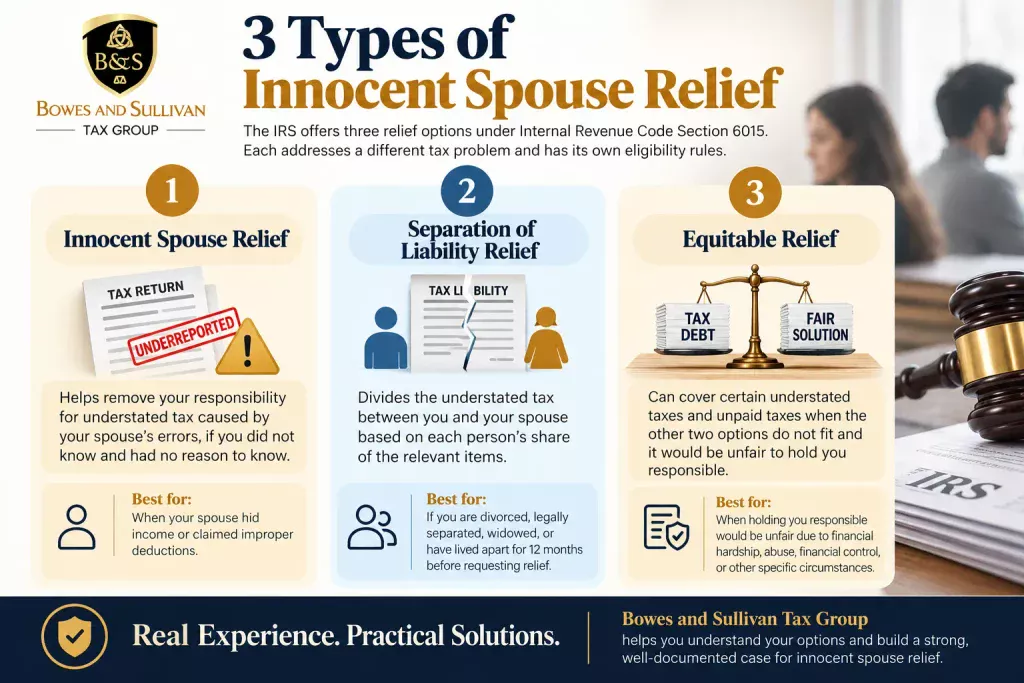
The Three Types of Relief Under IRC 6015
The IRS offers three main routes under Section 6015, and each has different eligibility rules. You do not need to select the perfect category before applying because the IRS reviews your facts and determines which relief, if any, applies.
Traditional Innocent Spouse Relief, Section 6015(b)
This form of innocent spouse relief addresses understated tax caused by an erroneous item on a joint return. You generally must show that you did not know, and had no reason to know, about the understatement when you signed the return.
The IRS also considers whether it would be unfair to hold you responsible. For example, your spouse might have concealed business income while you relied on records that appeared complete.
Separation of Liability Relief, Section 6015(c)
Separation of liability relief assigns the understated tax between you and your spouse based on each person’s share of the relevant items. It generally applies if you are divorced, legally separated, widowed, or have lived apart for the entire 12 months before requesting relief.
The IRS examines the income and assets connected to the understatement. This route generally cannot refund tax you already paid, and special rules apply to people who knew about errors or transferred assets to avoid tax.
Equitable Relief, Section 6015(f)
Equitable relief IRS rules can help when the other two routes do not fit, but holding you responsible would be unfair. This route can cover certain understated taxes and unpaid taxes from a joint return.
The IRS considers factors such as financial hardship, abuse, financial control, knowledge of the tax problem, and whether you received a significant benefit from unpaid taxes.
Do You Qualify? Key Factors the IRS Weighs
Eligibility depends on the return, the tax problem, what you knew, and your circumstances. The IRS reviews the full record rather than deciding based on marital status alone.
Knowledge Or Reason To Know Of The Understatement
The IRS asks whether you knew, or reasonably should have known, about the error when you signed the return. It can consider your education, role in the family business, access to financial records, and whether your spouse concealed information.
| For example, a spouse discovers that their former partner left substantial business income off a joint return. The IRS would examine whether they knew about the business, reviewed its records, benefited from the income, or had reason to suspect the return was wrong. |
A lack of knowledge helps, but it does not settle the claim by itself. Evidence of threats, abuse, or financial control can also matter, especially when you explain why you could not question the return.
The Two-Year Deadline, And When It Does Not Apply
Some requests must reach the IRS within two years of its first collection activity against you. This deadline applies to traditional innocent spouse relief and separation of liability relief in the circumstances set by law.
The rules differ for equitable relief IRS requests. For relief from an unpaid balance, you generally can apply while the IRS still has time to collect, usually 10 years from assessment, subject to extensions and other rules. Refund claims have separate limits, generally three years after filing or two years after payment, whichever is later.
Do not assume you have two years in every case. Check the notice date, the tax year, and the type of relief before deciding when to apply.
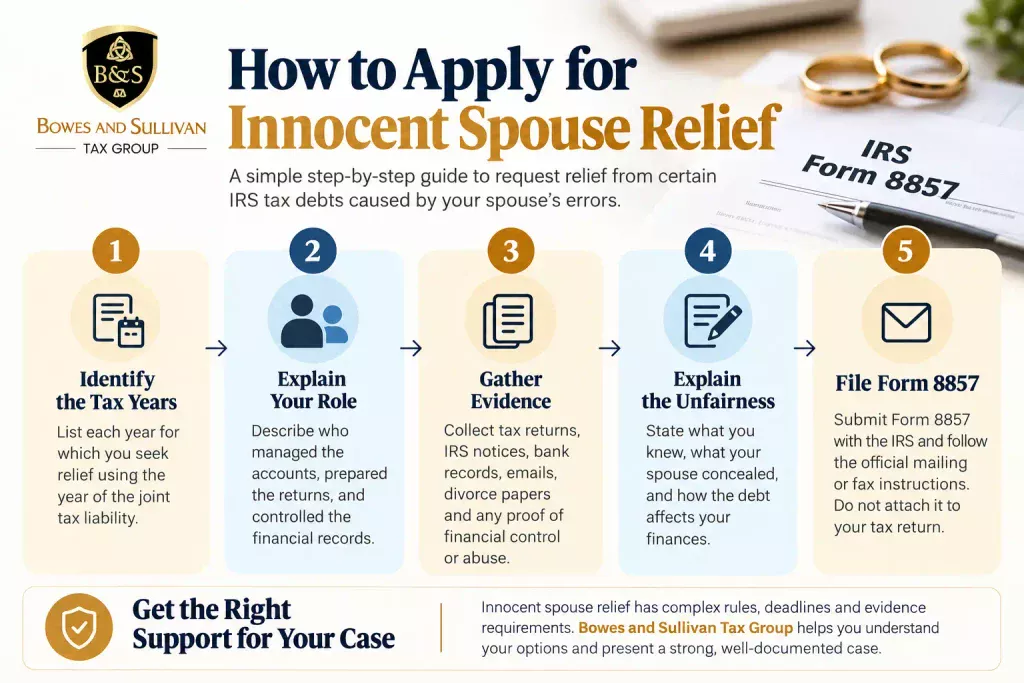
How to Request Innocent Spouse Relief Step by Step
You request relief by filing Form 8857 with the IRS and explaining why the tax debt should not be your responsibility. The form covers the main relief types, so the IRS can assess your eligibility based on the facts.
Completing and Filing Form 8857
Follow these steps to prepare a clear request.
- Identify the tax years. List each year for which you seek relief. Use the year of the joint tax liability, not the year the IRS took a refund.
- Explain your role. Describe who managed the accounts, prepared the returns, and controlled the business records.
- Gather proof. Include relevant tax returns, IRS notices, bank records, emails, divorce papers, and evidence of financial control or abuse.
- Explain the unfairness. State what you knew, what your spouse concealed, and how the debt affects your finances.
- File correctly. Use the current IRS Form 8857 and instructions. Follow the official mailing or fax instructions. Do not attach the form to your tax return.
The IRS lists the current form and instructions on its official website. Check that page before sending your application because filing details can change.
What Happens After You File, and How Your Spouse Is Notified
The IRS reviews your request and generally contacts your spouse or former spouse. The law requires this notice, even in cases involving domestic abuse. The IRS protects certain personal details, but it can share information you submit to support your claim.
The IRS says review can take six months or longer. While your request is pending, collection of the tax covered by the request generally stops, but interest and penalties continue. Keep filing and paying other taxes as required.
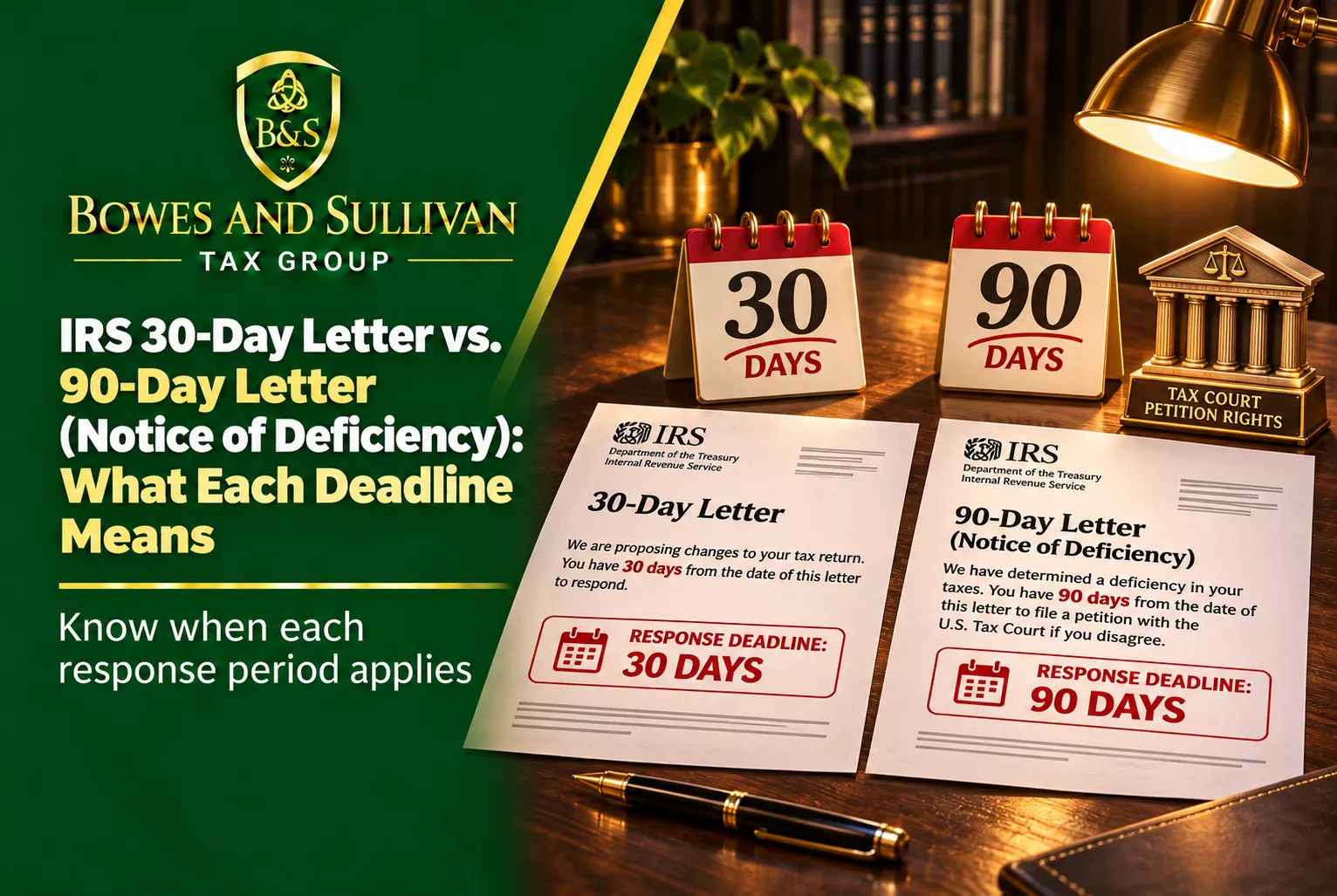
If the IRS denies your request, you generally have 30 days from the preliminary determination letter to appeal. Use Form 12509 and send it to the address on that letter. After a final determination, you generally have 90 days to petition the U.S. Tax Court. You can also petition if the IRS has not issued a final determination within six months of your request.
An Advisor’s Take: These Cases Are Won on Facts, Not Forms
A strong claim explains what happened, what you knew, and why the IRS should not hold you responsible. A completed form alone cannot prove that you qualify.
Why Documentation And Narrative Decide Innocent Spouse Claims
The IRS considers your financial role and personal circumstances. Your explanation should match the records and answer the questions the IRS uses to assess your claim.
Build an evidence file with:
- Joint tax returns and IRS notices for each year in question.
- Bank statements and business records showing who controlled the money.
- Emails or messages that show hidden income or misleading statements.
- Divorce or separation documents, if relevant.
- Records of abuse, threats, or financial control, where applicable.
- Current income, living costs, debts, and assets if you claim hardship.
In our practice, a useful starting point is to match each claim to a dated record. We also recommend explaining gaps in the evidence instead of leaving the IRS to guess why a document is missing.
| For example, if your spouse ran a business and kept its books private, explain how that limited your knowledge. Show any messages, account access records, or other proof that supports your account. |
If the IRS denies relief, a clear record also helps you challenge an IRS tax decision or pursue an appeal.
How Bowes & Sullivan Help You Request Relief and Resolve Any Balance
Bowes and Sullivan Tax Group helps you review IRS debts, assess relief options, prepare responses, and manage tax resolution matters. Our team includes former IRS agents, enrolled agents, certified tax resolution specialists, tax attorneys, and CPAs, with nationwide representation.
We focus on the facts behind your tax debt. Our team can help you:
- Review joint returns and IRS notices to identify the tax years and errors involved.
- Assess whether innocent spouse relief, separation of liability relief, or equitable relief IRS rules fit your circumstances.
- Organize financial records and build a clear explanation for your application.
- Prepare responses to IRS requests and help you respond to IRS letters within the stated deadlines.
- Review denial letters and explain options for appealing an IRS decision.
- Assess other options for resolving IRS tax debt if you remain liable for some of the balance.
We offer IRS tax resolution, audit representation, and tax debt services. We help you understand the rules and present your case clearly.
If you need to seek professional tax relief help, book a free consultation. We will review your situation and explain practical next steps.
Conclusion
A spouse’s tax mistake does not automatically mean you must bear the full cost. The IRS offers specific relief routes for joint returns, but each has its own rules, deadlines, and evidence requirements. Your best next step is to identify the tax years involved, preserve records, and explain what you knew about the return when you signed it.
Do not wait for collection pressure to grow before checking your rights. Bowes and Sullivan Tax Group can help you assess your claim, prepare a clear submission, and review other ways to resolve any balance that remains.
FAQs
The IRS says review can take six months or longer after you file Form 8857. Complex cases and requests for more evidence can extend the wait.
Yes. You can request innocent spouse relief while still married if you meet the relevant eligibility rules. Separation of liability has additional marital or household separation requirements.
You generally have 30 days to appeal a preliminary decision and 90 days after a final determination to petition the Tax Court.
Generally, yes. The IRS generally pauses collection of the tax covered by a pending request, but interest and penalties continue to accrue.