An IRS substitute for return can appear when you fail to file a required tax return, and the IRS decides to prepare one for you. The IRS builds the SFR from income information it already has, such as W-2s and 1099s, but it generally leaves out the deductions, credits, and other details you would have included on your own return.
That can leave you with a much larger tax bill than you actually owe. If you ignore the SFR notices, the proposed balance can become an assessment and eventually lead to collection action. This guide explains how an SFR works, what notices to expect, and how filing your own return can correct the IRS’s calculation.
Key Takeaways
- An SFR is a return the IRS prepares under IRC 6020(b) when you fail to file a required one.
- It is built from third-party reports such as W-2s and 1099s, using single or married filing separately status and the standard deduction, so it tends to overstate what you owe.
- The notices start from CP59 and its reminders, to a CP2566 proposal, to a CP3219N Notice of Deficiency with 90 days to respond (150 if you are outside the U.S.).
- If you ignore the notices, the tax is assessed, and the IRS generally has 10 years to collect it.
- Filing your own original return replaces the SFR through audit reconsideration and can lower the balance.
- An SFR does not protect your refund rights, and it can block bankruptcy discharge of that year’s tax.
What a Substitute for Return Actually Is
An SFR is a legal tool the IRS uses to put a number on your account when a required return never arrives. The SFR IRS process relies on information already available to the agency to calculate the tax.
The IRS’s authority to file for you under IRC 6020(b)
Section 6020(b) of the Internal Revenue Code lets the IRS prepare a return for anyone who fails to file a required one, using its own knowledge and whatever information it can obtain. A return made this way is treated as prima facie good and sufficient for legal purposes, which is why the resulting tax can be assessed and collected.
Treasury Regulation 301.6020-1 explains the mechanics. A signed IRS document counts as your return if it identifies you by name and taxpayer ID number, contains enough information to compute your tax, and purports to be a return.
The authority is not limited to individuals. The IRS also uses it for employment, excise, and partnership returns. A business with unfiled payroll returns such as Form 941 can receive a Letter 1085-A instead of a CP2566, under the separate business process described in IRM 5.18.2. The logic is the same, but the letters and response steps differ.
What data the IRS uses – and what it leaves out
The IRS builds an SFR from information returns that payers file under your taxpayer ID number. These include Forms W-2 and the 1099 series for miscellaneous income, brokerage sales, interest, dividends, and canceled debt. It can also draw on Schedule K-1 partnership income. The CP2566 notice states that the IRS calculated your tax, penalty, and interest from wages and other income reported by employers, financial institutions, and others.
What the IRS leaves out is everything only you know. That means business expenses, itemized deductions, dependents, your correct filing status, and the credits that come with them. That gap is where the inflated balance comes from.
Why an SFR Almost Always Overstates What You Owe
The IRS is not being careless. Its system works from a short list of assumptions that favor the government, and those assumptions rarely match a real household or a real business.
Single filing status, standard deduction, and zero credits
The Internal Revenue Manual says the automated program uses only single or married filing separately status when it prepares a proposed assessment. The Taxpayer Advocate Service adds that the program assumes single status unless your account shows a prior joint filing. It also treats you as having no dependents, and allows only the standard deduction even when the IRS holds records supporting more.
Those defaults cost real money. A married couple loses the wider joint brackets. A parent loses head of household status and child-related credits. A homeowner whose mortgage interest exceeds the standard deduction loses the itemized deduction. TAS found that for assessments made in fiscal years 2011 through 2014, the IRS later abated about $10 billion, or 29 percent of the total. The most common reasons were filing status and itemized deductions. That report is older, but it is the most recent published breakdown of SFR abatements we could find.
| For assessments made in fiscal years 2011 through 2014, the IRS assessed nearly $34 billion through its SFR program and later abated about $10 billion. The most common reasons were filing status and itemized deductions. |
A self-employed example: taxed on gross, not net
Self-employed taxpayers feel this gap most. Suppose a freelance designer receives $80,000 on Forms 1099-NEC and spends $30,000 on software, contractors, equipment, and a home office. The IRS only sees the $80,000, and because an SFR allows no deductions beyond the standard one, it starts from that full amount. A return you prepare reports $50,000 of net profit instead, so $30,000 of income never reaches the tax base. The figures are illustrative, but the mechanism is real, and the IRS itself notes that filing may reduce the amount due if you can claim expenses or deductions.
| Item | IRS-prepared SFR | Return you file |
| Filing status | Single, or married filing separately if a prior joint return exists | Any status you qualify for, including joint or head of household |
| Deductions | Standard deduction only | Standard or itemized, whichever is larger |
| Dependents and credits | Not considered | Claimed if you qualify |
| Business expenses | Not allowed | Deducted on the proper schedule |
| Income in the example above | $80,000 | $50,000 net profit |
An SFR can significantly overstate your taxable income, especially if you’re self-employed. Filing your own return lets you claim the deductions and credits the IRS’s calculation leaves out.
The Notice Sequence: How an SFR Reaches You
For taxpayers wondering why the IRS filed my taxes for me, the answer usually begins with a series of notices sent after a required return goes unfiled. The table below shows the usual order, though not every taxpayer receives every letter.
| Notice | What it tells you | Your window |
| CP59 | The IRS has no record of your prior return | Follow the notice |
| CP515, CP516, CP518 | Reminders, ending with a final reminder | Follow each notice |
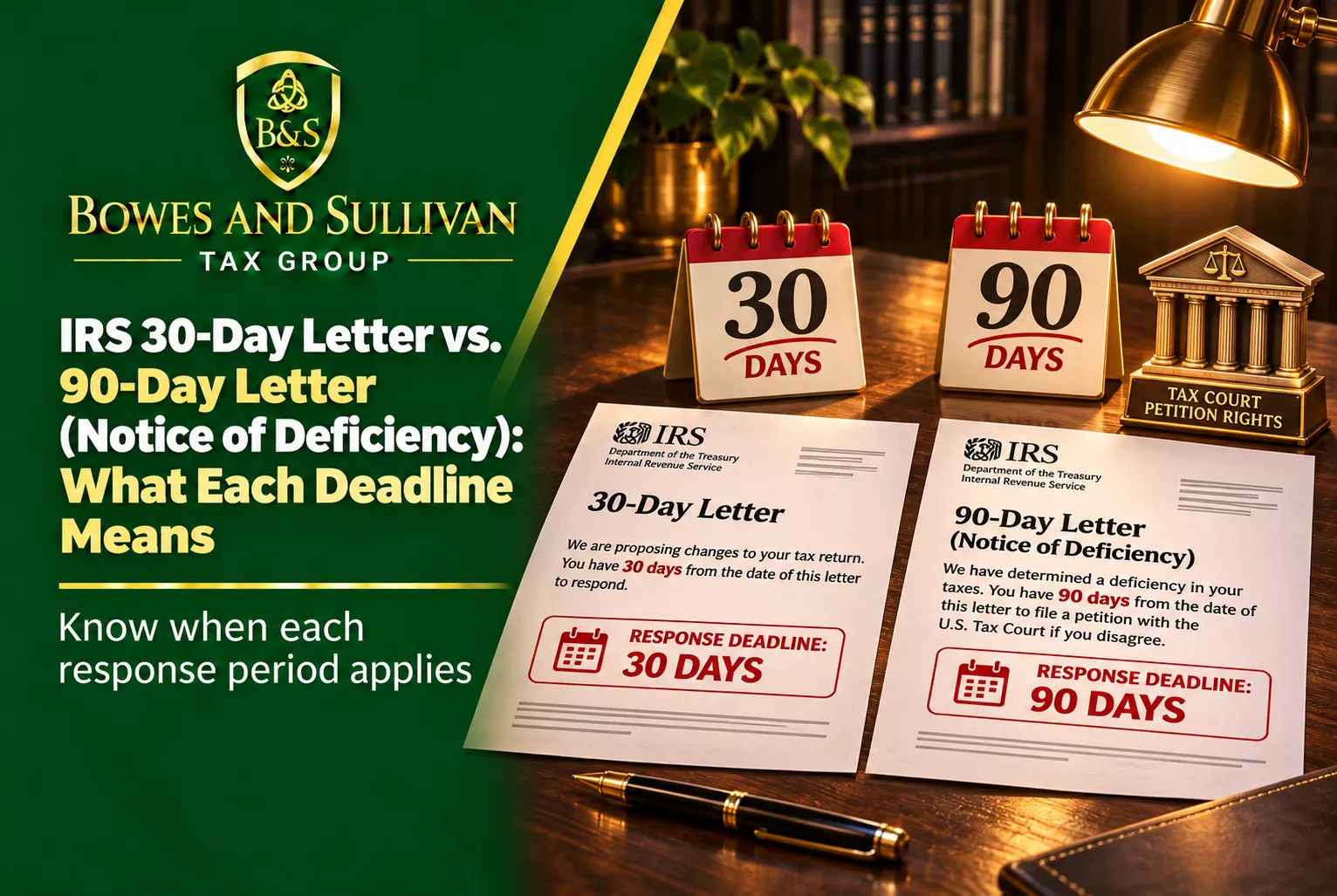
| CP2566 / Letter 2566 | Proposed assessment built from income reports | 30 days |
| CP3219N / Letter 3219 | Notice of Deficiency | 90 days (150 outside the U.S.) |
| Assessment | Tax, penalties, and interest recorded | 10-year collection clock starts |
The IRS generally gives you several opportunities to file before an SFR becomes an assessment. Pay close attention to each notice and its response deadline.
From the CP59 “we have no return” notice to the CP2566 proposed SFR
The IRS’s list of past-due return notices starts with the CP59, which says the IRS has no record of a prior return. The CP515, CP516, and CP518 follow as reminders, with the CP518 serving as a final one. If those go unanswered, the IRS may send a CP2566, also issued as Letter 2566. It shows the tax, penalty, and interest calculated from income reports and asks you to either file your return or accept and pay the proposed amount. Under IRS procedures, this is the 30-day letter, and the deadline is printed on your notice.
A variation is worth knowing. If the IRS is already holding a refund for another year, you may receive a CP2566R instead, which warns that all or part of that refund may be applied to the debt if you do not respond.
The CP3219N Notice of Deficiency and the 90-day Tax Court window
When the 30-day letter goes unanswered, the IRS issues a Notice of Deficiency, CP3219N. The IRS describes it as a 90-day letter. You have 90 days from the date on the notice to petition the U.S. Tax Court, or 150 days if you are outside the country. The Tax Court has simplified small case procedures when the amount in dispute, including penalties, is $50,000 or less per tax year.
Two details from the same IRS page are easy to miss. Filing a return during this window does not extend your time to petition the Tax Court. The IRS will still accept a return filed after the 90 days, but you may face significant processing delays.
What Happens If You Ignore It
Ignoring the notices can make the situation more serious. Once the response window closes, the IRS can move forward with an automated substitute for return, turning the proposed tax into an assessed debt.
Assessment, and the 10-year collection clock that follows
If you do not resolve the delinquency or petition the Tax Court within 90 days, the IRS assesses the proposed tax, penalties, and interest, and collection proceeds on whatever is unpaid. The IRS generally has 10 years from the assessment date to collect, and substitute for return balances have their own collection statute expiration date. During that period, the IRS can use enforced collection actions, including federal tax liens and levies on wages and bank accounts.
The balance also keeps growing. The failure-to-file penalty is 5 percent of the unpaid tax per month, and the failure-to-pay penalty is 0.5 percent per month. Each maxes out at 25 percent, for a combined ceiling of 47.5 percent. Interest is 7 percent, compounded daily, for the quarter beginning October 1, 2026. If the assessed amount is already more than you can manage, IRS tax debt relief options such as payment plans become the next question. Waiting does not help either, because when no return has been filed, the IRS has no time limit to assess tax for that year.
Read More: Professional Back Taxes Help & Resolution
How to Replace an SFR: File Your Own Return
Filing your own return is the single most effective response at every stage. If you have several years to catch up on, unfiled tax returns help can keep the process organized, because each year has its own notice and deadline.
Filing an original return and the audit reconsideration process
The IRS says that even when it files a substitute return, it is in your best interest to file your own so you can claim the deductions and credits you are entitled to, and that it will generally adjust your account to the correct figures. Once the SFR has been assessed, the IRS processes your original delinquent return through audit reconsideration, the same process it uses when a taxpayer contests an SFR determination. The steps are straightforward:
- Get your IRS tax records to see the income reports on file for that year.
- Gather what the IRS cannot see: expense records, mortgage interest statements, dependent information, and any other income you received.
- Prepare the return for the correct tax year. The IRS allows e-filing only if the return is from the past two years. Older returns go by mail with the response form from your notice.
- Send it to the location printed on your notice, as the IRS instructs on its past due returns page.
- Pay what you can with the return, since interest and late-payment penalties keep accruing on the unpaid balance.
If the corrected balance is still more than you can pay at once, you can ask about a payment plan. Some taxpayers also explore an offer in compromise, but that is a separate application with its own eligibility rules, and it comes after the return is filed and the true balance is known.
Read More: IRS Unfiled Tax Returns Help
The deductions, credits, and filing status that shrink the balance
The reduction comes from replacing the IRS’s assumptions with your facts. The items that most often change the outcome are:
- Filing status: Married filing jointly or head of household instead of single or married filing separately. TAS listed both among the most common reasons for abatements.
- Itemized deductions: Mortgage interest, state and local taxes, and charitable gifts that exceed the standard deduction.
- Business expenses: Costs that reduce self-employment income to net profit.
- Dependents and credits: Claiming eligible children and credits such as the Earned Income Credit, which must be claimed within three years of the due date.
There is one caution. The IRS tells taxpayers to use the income shown on the notice along with any other income they received. If you had cash income or payments that no one reported, your return must include them, and in that case the tax can go up rather than down.
| The notice shows only income that payers reported. If you received cash or other payments that no one reported, they belong on your return, and the tax can increase instead of decrease. |
Two Things People Miss About SFRs
The consequences of an SFR go beyond the balance shown on the notice. Two less obvious effects can continue to matter long after the initial assessment.
An SFR doesn’t preserve your refund – and can block a bankruptcy discharge
An SFR can only produce a bill. If your withholding exceeded your true tax, the IRS says you must file within three years of the due date to receive a refund. The general refund rule is the later of three years from filing or two years from payment, and withholding counts as paid on the due date. IRS Chief Counsel guidance notes that when no return was filed by the taxpayer, the claim window is two years from payment. A refund for an old year can therefore disappear while the SFR sits on your account.
Bankruptcy adds a second reason. The Bankruptcy Code does not discharge a tax debt for which no return was filed, and it defines “return” so that an IRS-prepared 6020(b) return does not count. IRS guidance also tells its staff to evaluate dischargeability differently depending on whether your own return came before or after the SFR assessment, and it carves out the 8th Circuit, which shows results vary by location. In practice, that is a reason to file your own return before assessment when you can, and to file for years already assessed. If bankruptcy is on the table, speak with a bankruptcy attorney about the specific years first.
| Whether an SFR-related tax can be discharged depends on the tax year, the timing of your own return, and the circuit you file in. Talk to a bankruptcy attorney about each year with an SFR assessment before you file. |
Read More: IRS Tax Debt Relief Options
An Advisor’s Take: Respond Before the 90 Days Run Out
The pattern across every stage above is the same. The earlier your own return reaches the IRS, the more choices you keep.
Why acting during the notice window keeps every option open
At the 30-day stage, filing your return stops the SFR from moving forward. At the 90-day stage, you can still file, or you can petition the Tax Court if you dispute the IRS’s numbers. After assessment, you can still fix the balance through reconsideration, but collection can happen in parallel and processing takes longer. We tell taxpayers to treat the date printed on the CP2566 as the real deadline, not the later Notice of Deficiency.
This is also where tax relief specialists earn their fee. They can pull your transcripts, rebuild the return, and deal with the IRS directly once you sign a Form 2848 power of attorney. That takes the pressure of the calls and paperwork off you while the deadline is running.
Take Back Control From an IRS-Filed Return
An SFR is the IRS’s best guess, built without your expenses, your family, or your real filing status, and it gets more expensive the longer it sits. Answering the CP2566 or the Notice of Deficiency with your own return is the most effective way to shrink it, and the sooner that return is filed, the more options stay open.
At Bowes and Sullivan Tax Group, we help taxpayers pull their IRS records, prepare the missing returns, and replace SFR balances with accurate ones. If a balance remains, we work with you on a payment plan or another resolution that fits your income.
If you have received a CP2566, a CP3219N, or any notice you don’t recognize, contact us for a free consultation, and we will help you map out your response before the deadline runs out.
FAQs
Yes. The IRS says it is still in your best interest to file your own return after it files a substitute, and that it will generally adjust your account to the correct figures. After assessment, the return is handled through audit reconsideration, which applies to assessments that remain unpaid. A late return can face processing delays, and filing does not extend the Tax Court petition deadline.
Often, but not always. Your return replaces the IRS’s assumptions with your real filing status, deductions, dependents, and credits, which is why the IRS itself says filing may reduce the amount due. The return must also include any income beyond what appears on the notice, so unreported income can raise the tax. Late-filing and late-payment penalties and interest still apply to whatever tax remains.
The IRS assesses the tax, penalties, and interest, and collection can begin, including liens, levies, and offsets of refunds it holds. Interest compounds daily at 7 percent for the fourth quarter of 2026. The 10-year collection period starts on the assessment date.
Only in a narrow sense. Section 6020(b) makes an IRS-prepared return legally sufficient to assess tax, but it is not a return you filed. The regulation cross-references a rule that such a return does not start the assessment time limit, and the Bankruptcy Code excludes it from its definition of a return. Filing your own return is what actually closes the delinquency.
There is no time limit on assessing tax for a year in which no return was filed. As a matter of policy, the IRS generally enforces filing for the last six years, and going further back requires managerial approval. That policy is not a statute of limitations, and you can file older returns voluntarily.