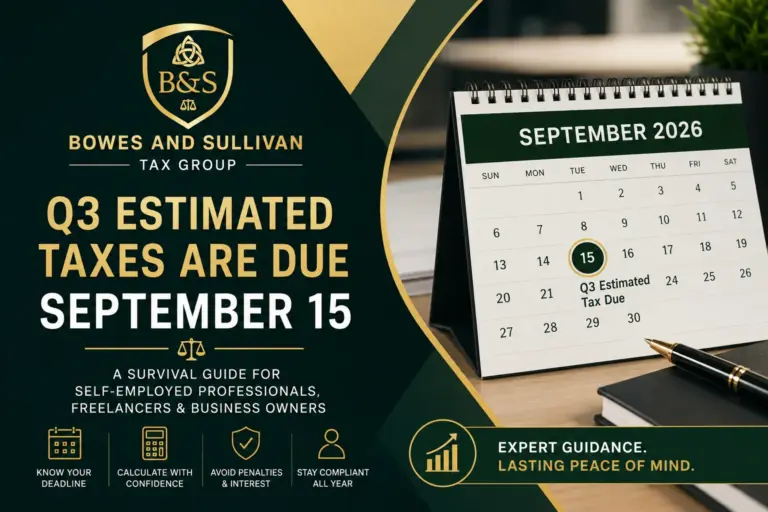
September can be an expensive month for self-employed professionals, freelancers, investors, and small business owners. The Q3 estimated tax payment is due September 15, 2026, and it covers income earned during June, July, and August. If you earn income without taxes being withheld from each paycheck, you may need to make estimated payments throughout the year to avoid a larger tax bill and a potential penalty later.
The September payment does not have to be complicated, but it is easy to get wrong if you are unsure how much to pay or whether you need to pay at all. This guide breaks down who needs to make a Q3 payment, how the safe harbor rules work, how to make the payment, and what you can do if you do not have enough cash to pay the full amount by September 15.
What the Q3 Estimated Tax Payment Actually Is
The U.S. tax system runs on a pay-as-you-go basis. Employees have this handled automatically through payroll withholding. Anyone who earns income without that automatic deduction, including freelancers, contractors, business owners, and investors, has to replicate that process manually through quarterly estimated payments.
Why the income you earned over the summer is taxed now
The Q3 payment is not a prepayment or a guess. It corresponds directly to income earned between June 1 and August 31, 2026. The IRS structures the year so that tax gets paid close to when the income is actually received, rather than in one lump sum the following spring. Waiting until April to settle up on a full year of self-employment income is exactly what triggers the penalty this guide covers below.
Who has to pay: the self-employed, investors, and anyone under-withholding
For people managing quarterly taxes self employed income can create. Estimated payments generally apply to:
- Self-employed individuals and freelancers
- Small business owners operating as sole proprietors, partners, or S-corp shareholders
- Investors with significant capital gains, dividend, or interest income
- Anyone whose W-2 withholding does not cover their full tax liability, including people with side income on top of a regular job
Business owners who owe regularly often find it easier to fold quarterly estimated tax payments into a broader tax preparation plan rather than calculating each one from scratch.
The September 15 Deadline and the Full 2026 Schedule
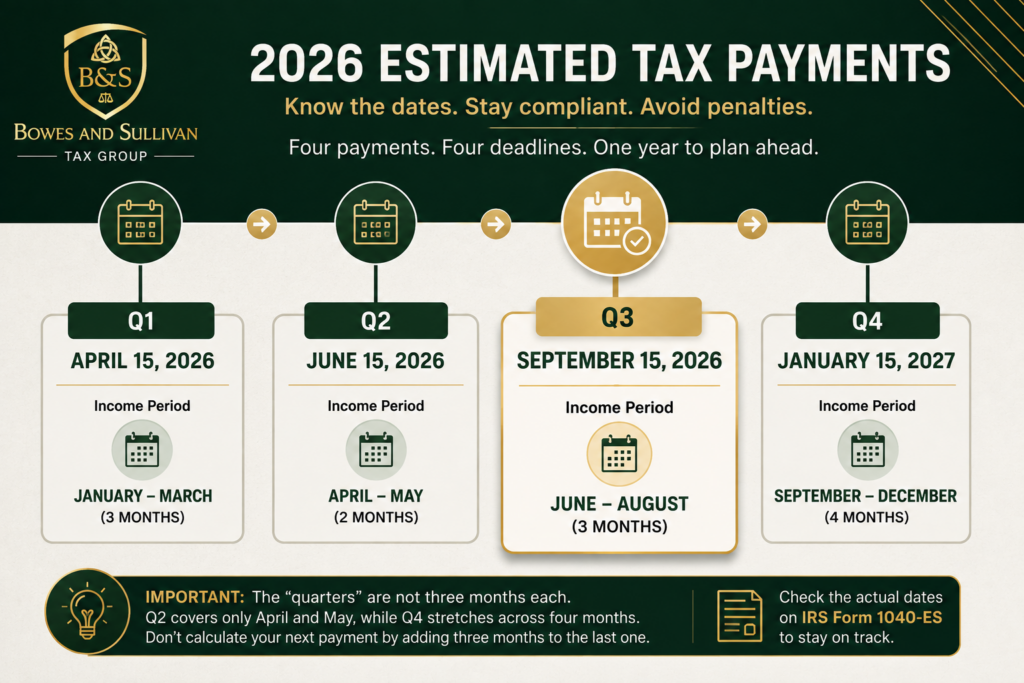
The 2026 estimated tax calendar has four due dates, and the September 15 estimated tax payment is one of the most important dates for taxpayers with self-employment or other income not subject to withholding. The periods they cover are not evenly spaced. That uneven spacing is exactly what catches people off guard, since many taxpayers assume the next payment is simply three months after the last one.
All four due dates, and why the “quarters” aren’t equal
| Payment | Due Date | Income Period Covered |
| Q1 | April 15, 2026 | January – March |
| Q2 | June 15, 2026 | April – May (2 months) |
| Q3 | September 15, 2026 | June – August (3 months) |
| Q4 | January 15, 2027 | September – December |
| The “quarters” are not three months each. Q2 covers only April and May before its June 15 due date, while Q4 stretches across four months. Don’t calculate your next payment by adding three months to the last one. Check the actual date on the IRS Form 1040-ES schedule instead. |
Do You Even Have to Pay? The $1,000 Rule
Not everyone with self-employment or investment income owes a Q3 payment. The obligation kicks in only past a specific threshold, and it is worth confirming where you stand before assuming you owe anything at all, especially before the estimated tax deadline.
When your withholding already covers you
If you expect to owe less than $1,000 in tax for the year after subtracting withholding and refundable credits, no estimated payment is required, according to the IRS’s guidance on estimated taxes. This is common for people who have a day job with W-2 withholding and only modest side income. Corporations follow a similar rule, but their threshold is $500. If your withholding already tracks close to your total liability, run a quick projection before assuming you owe anything for Q3.
The Safe Harbor That Prevents a Penalty
This is the part of the tax code that actually protects you, and understanding the estimated tax safe harbor is worth doing before September 15 rather than after.
Pay 90% of this year, or 100% of last year (110% over $150K AGI)
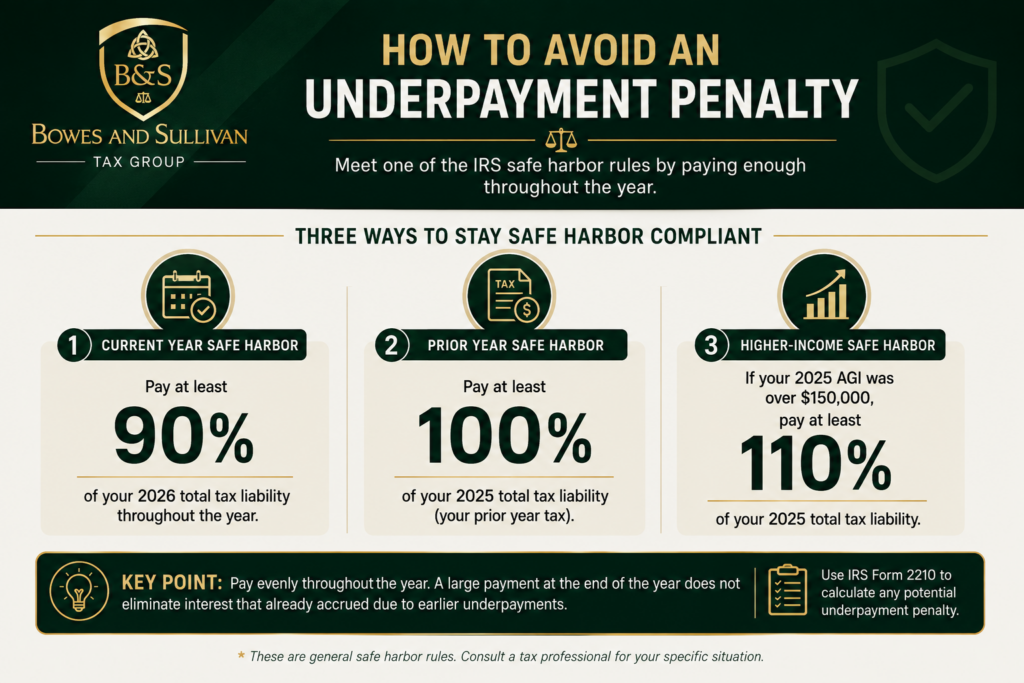
The IRS will not charge an underpayment penalty as long as your total withholding and estimated payments for the year equal the smaller of:
- 90% of the tax you will actually owe for 2026, or
- 100% of the tax shown on your 2025 return (110% if your 2025 adjusted gross income was over $150,000, or $75,000 if married filing separately)
This threshold is spelled out in the instructions to Form 1040-ES, which also walks through the underlying calculation.
| Safe Harbor Method | Requirement | Best For |
| Current-year (90%) | Pay 90% of your actual 2026 liability | Taxpayers with falling income this year |
| Prior-year (100% / 110%) | Pay based on last year’s tax bill, regardless of this year’s income | Taxpayers with rising or unpredictable income |
Why the prior-year number is the safer target
The current-year method requires an accurate projection of income you have not fully earned yet, which is risky if your business has an unusually strong second half. The prior-year method uses a number that is already locked in, so there is no estimation risk involved. For anyone whose income is trending upward in 2026, basing payments on last year’s return is usually the more conservative, penalty-proof choice.
How the Underpayment Penalty Really Works
The underpayment penalty is one of the most misunderstood parts of estimated taxes, and that misunderstanding is exactly what leads taxpayers to believe a large April payment fixes everything; it does not.
It’s calculated per quarter: a missed payment isn’t fixed in April.
This is the detail that trips up the most taxpayers. The underpayment penalty under IRC Section 6654 is not a single, year-end calculation. It is assessed separately for each quarter, with interest running from that specific quarter’s due date. Sending a large payment with your April return does not erase the interest that accrued on a missed September installment. Each period stands on its own.
The current 7% rate and how interest compounds
The penalty is charged as interest, at a rate equal to the federal short-term rate plus 3 percentage points. For Q3 2026, that rate works out to 7%, compounded daily. It is reviewed and can shift every quarter, so the cost of underpaying is not fixed from one period to the next. If a penalty has already been assessed and you believe it does not reflect your actual situation, it is worth exploring IRS penalty abatement before simply paying the notice in full.
| If you first became liable for quarterly payments during Q3, for example, because you started a business or a large capital gain hit mid-year, special “concentrated income” rules may apply. You may need to pay 75% of the tax due by September 15 and use Form 2210 to annualize your income properly, rather than paying a full quarter’s worth of a number you did not have all year. |
Read More: CP14 Notice: What Your First IRS Bill Really Means and What to Do Next
How to Pay Your Q3 Estimate Fast
Several payment channels are available, so knowing how to pay estimated taxes can help you choose the right option based on speed and whether the payment is personal or business.
IRS Direct Pay, EFTPS, card, or applying a prior refund
There are several ways to get a Q3 payment to the IRS before the deadline:
- IRS Direct Pay: A free, direct transfer from a bank account
- EFTPS: The Electronic Federal Tax Payment System, useful for business owners who pay quarterly on a recurring basis.
- Debit card, credit card, or digital wallet: Convenient but typically carries a processing fee
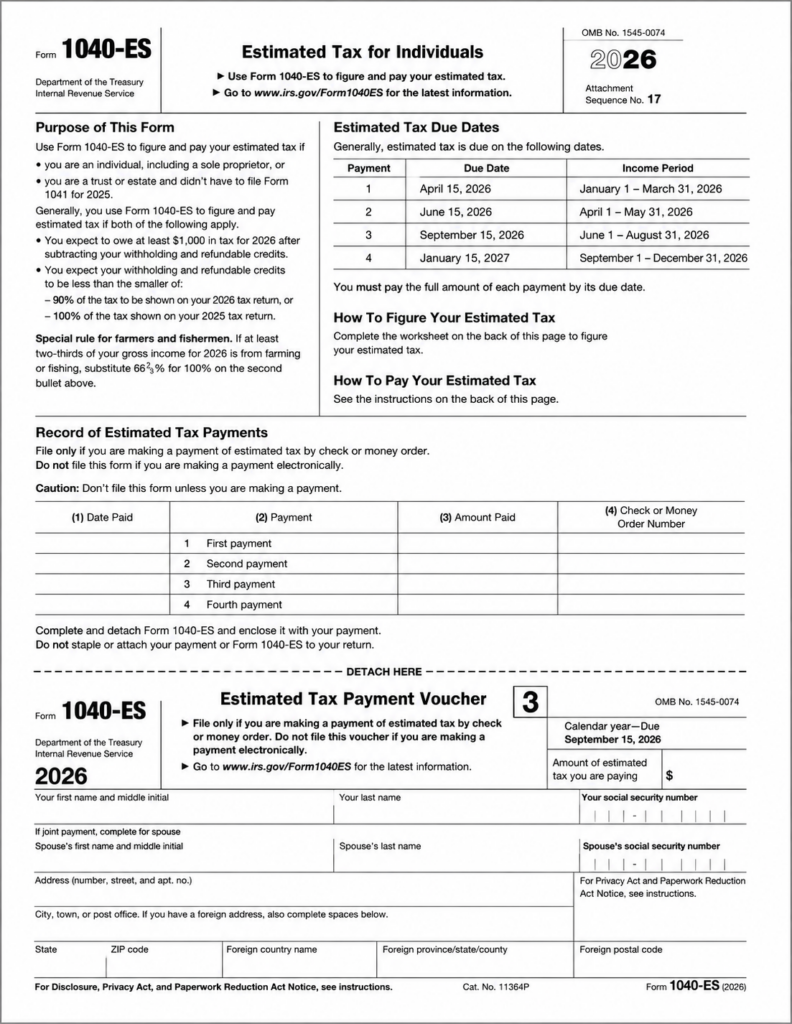
- Mailing a check: Sent with the Form 1040-ES payment voucher
- Applying a prior-year refund: If you overpaid in 2025, that refund can be applied forward to a 2026 estimated payment instead of being refunded to you.
The withholding trick that counts as paid all year
One detail that surprises a lot of taxpayers: withholding is treated by the IRS as paid evenly across the entire year, no matter when it actually happens. That means if you are behind on estimated payments, increasing your W-2 withholding late in the year, or a spouse’s withholding if you file jointly, can retroactively cover an earlier shortfall in a way that a late estimated payment cannot.
| September 15 is a double deadline for business owners. The same date is also the extended filing deadline for calendar-year S-corporations (Form 1120-S) and partnerships (Form 1065). Missing it triggers a separate penalty of roughly $235 per shareholder or partner, per month, under IRC Sections 6699 and 6698, on top of anything owed on your personal Q3 estimate. |
What to Do If You Can’t Pay by September 15
Cash flow gaps happen, especially for business owners whose income is uneven across the year. How you respond to a shortfall matters more than the shortfall itself.
Pay what you can now to shrink the penalty and interest
For taxpayers who cannot pay the balance at all, a structured IRS installment agreement spreads what is owed over monthly payments. This can make the balance more manageable while giving the taxpayer a clear payment plan.
In cases of genuine financial hardship, IRS Currently Not Collectible status can pause collection activity while a longer-term plan is worked out. The IRS reviews the taxpayer’s financial situation before determining whether collection should be suspended.
If back taxes have already piled up from previous quarters, getting help with back taxes sooner rather than later can limit how much interest compounds against you. Addressing older tax debt early can also help prevent the balance from becoming harder to manage.
| A missed payment isn’t a lost cause. Waiting until you can pay in full is the most expensive option. A partial payment now, followed by a plan for the balance, almost always costs less than silence. |
For taxpayers who are already behind on multiple periods, exploring IRS tax debt relief options can prevent a manageable shortfall from becoming a much larger balance with penalties layered on top of penalties. The right option depends on the taxpayer’s circumstances and the amount owed.
Read More: Streamlined vs. Partial Pay Installment Agreement: Which One Fits Your Situation
An Advisor’s Take: Turning a Missed Deadline Into a Plan
A missed Q3 deadline is rarely about carelessness. It is almost always about bandwidth, and the fix is structural rather than heroic.
When to stop guessing and set up a system for the year
Most people who miss the Q3 deadline are not being careless. They are simply running a business, and quarterly taxes get pushed aside by everything else demanding attention that week. The fix is rarely a single scramble in September. It’s a system: a set-aside percentage of income each month, set a calendar reminder well before each due date, and do a mid-year check-in to see whether income is tracking above or below expectations.
For business owners who consistently find themselves catching up rather than staying ahead, working with tax relief specialists can turn a recurring scramble into a predictable, manageable part of running the business, rather than a stressful surprise four times a year.
Read More: Tax Debt Settlement: What Realistic Outcomes Actually Look Like
Get Help With Your Tax Situation
September 15 can sneak up quickly, especially when you are busy running a business, managing freelance work, or keeping up with other sources of income. Taking care of your Q3 estimated tax payment on time, paying what you can, and dealing with any shortfall early can help keep a manageable tax bill from turning into a much bigger problem.
Bowes and Sullivan Tax Group helps taxpayers deal with back taxes, IRS penalties, tax debt, and payment options when things have become difficult to manage. The team can help you understand your situation, look at the options available, and work toward a practical way to resolve your tax debt.
If you need help with your tax situation, contact Bowes and Sullivan today and take the first step toward getting your tax debt under control.
FAQs
What happens if I miss the September 15 estimated tax deadline?
You will be charged interest on the shortfall from September 15 until the amount is paid, at the current underpayment rate. The penalty applies to that specific quarter regardless of what you pay later in the year.
How much should my Q3 payment be?
It depends on which safe harbor method you are using. If you are basing payments on last year’s return, divide your target annual total (100% or 110% of 2025 tax) across your four payments. If you are using the current-year method, base it on your actual year-to-date income and projected total.
Can I skip Q3 and just pay everything in April?
You can, but it will cost you. The penalty is calculated per quarter, so skipping Q3 and paying in full at filing time still results in interest charged on the missed September installment.
What’s the fastest way to pay estimated taxes?
IRS Direct Pay is typically the quickest free option, transferring funds directly from a bank account with instant confirmation. EFTPS is a strong choice for business owners who pay on a recurring schedule.
Does a filing extension give me more time to pay?
No. A filing extension only extends the time to file a return, not the time to pay taxes owed. This applies to both individual estimated payments and the extended S-corp and partnership filing deadline, which also falls on September 15.