
Getting an IRS audit notice can be unsettling, especially when you don’t know how long the process will last. The good news is that most audits do not drag on indefinitely. The timeline can vary significantly depending on the type of audit, how quickly you provide the requested information, and whether the IRS needs additional documentation.
The IRS audit timeline for most cases ranges from a few months to about a year, although more complicated examinations can take longer. This guide breaks down realistic timelines for different audit types, the factors that can speed up or delay an audit, and how the three-year statute of limitations fits into the process. By the end, you’ll have a clearer idea of how long your audit may take and what to expect along the way.
Key Takeaways
|
The Short Answer: Usually Under a Year
Before breaking down the individual audit types, it helps to see the overall pattern the IRS itself follows. There’s an internal deadline shaping almost every audit, and it matters more than most taxpayers realize.
Why most audits close well before the statute runs out
The IRS has three years from your filing date to assess additional tax, but very few audits use that entire window. Internal Revenue Manual guidance tells examiners to open and close audits within roughly 26 months of the return’s due date or filing date. That leaves a built-in buffer before the statute expires.
That internal target, more than the statute itself, is why how long IRS audit cases actually take tends to land well under a year for most taxpayers. Agents are working against their own clock, not just yours.
Read More: What to Expect During an IRS Field Audit
Timelines by Audit Type
The single biggest factor in your IRS audit process timeline is which of the three audit types you’re facing. Each one moves at a different pace, involves different IRS personnel, and covers a different slice of your return.
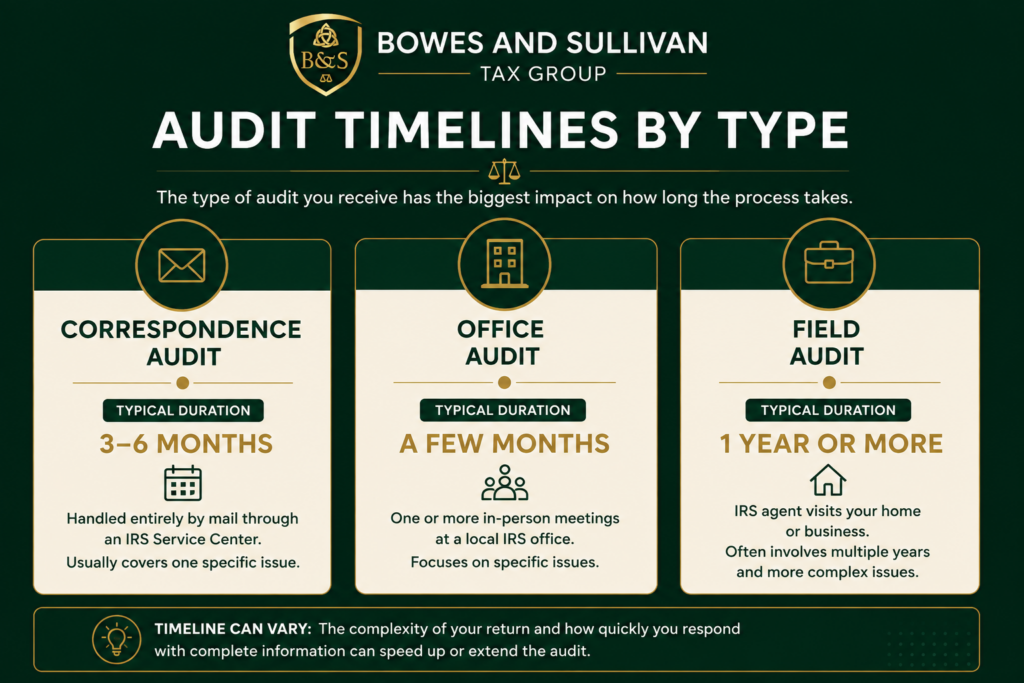
| Audit Type | Typical Duration | How It’s Conducted |
| Correspondence (mail) | 3 to 6 months | Entirely by letter, through an IRS Service Center |
| Office | A few months | One or more in-person meetings at a local IRS office |
| Field | A year or more | IRS agent visits your home or business, often multi-year scope |
Correspondence (mail) audits: typically 3-6 months
A correspondence audit is conducted entirely by mail, and it’s the most common and least invasive type. The IRS sends a letter asking for documentation on one specific item, such as a deduction or a credit, and nothing more. Most taxpayers never speak to an actual person during the entire process.
The case typically wraps up within three to six months once you respond completely and on time. This is genuinely the fastest form of audit duration, and it rarely requires much back and forth if your records are organized from the start.
Office audits: a few months, centered on one meeting
An office audit involves a scheduled meeting at a local IRS office, usually because the issues under review are more involved than a simple correspondence audit, but not extensive enough to warrant a field visit. You’ll typically get a letter naming the specific line items in question ahead of time.
These audits generally run a few months from the initial notice to resolution. How long depends largely on how many issues surface during that meeting, and whether the examiner needs follow-up documentation afterward.
Field audits: often a year or more
A field audit is the most comprehensive type, and an IRS revenue agent visits your home or place of business directly rather than working from a distance. These are reserved for complex returns, often involving business income, multiple tax years, or cases where the IRS suspects significant unreported income.
Because the scope is broader and frequently spans more than one filing year, a correspondence vs field audit comparison shows field cases regularly taking a year or more to close. Some run considerably longer if new issues surface midway through.
| The 26-Month Rule Internal Revenue Manual guidance directs examiners to close audits within about 26 months of the return’s due date or filing date. This internal target, well inside the three-year statute of limitations, is a major reason most audits move faster than taxpayers expect. |
What Makes an Audit Take Longer
Audit type sets the baseline, but a handful of other factors can stretch any of these timelines considerably. It’s worth knowing which ones apply to your situation.
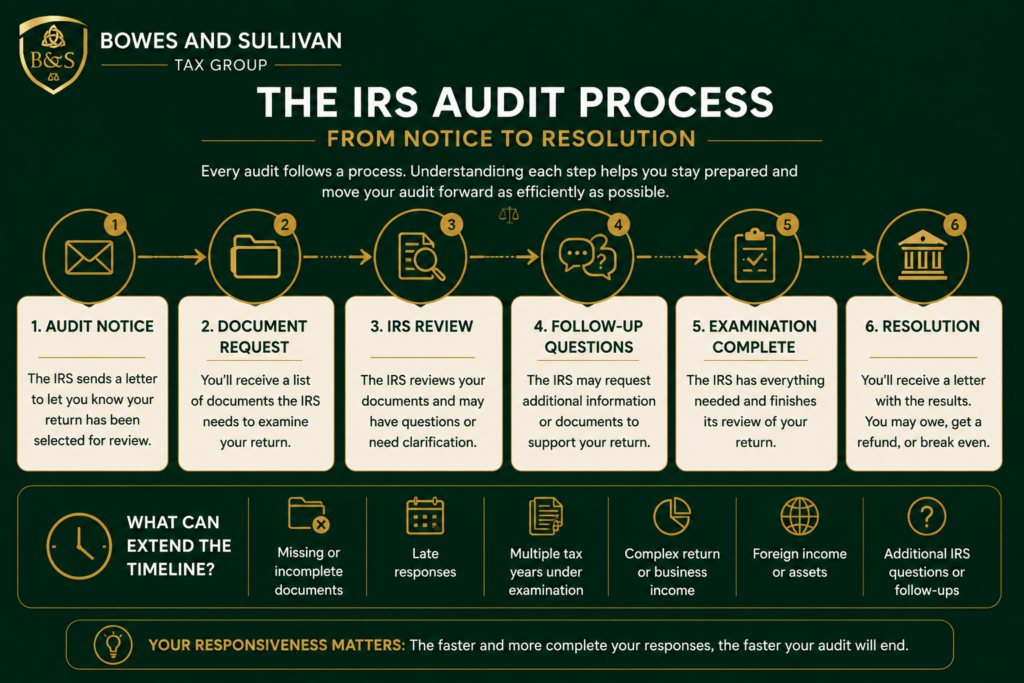
Complexity, multiple years, and business or foreign income
The more issues an audit covers, the longer it tends to run, plain and simple. A single-item correspondence audit resolves quickly because there’s only one thing to prove. A case touching multiple tax years, business income reported on a Schedule C, or foreign income and assets is a different animal entirely.
Each of those layers brings in more documentation requirements and often more IRS personnel to review them. The examiner has to fully substantiate every issue before closing the file, and that simply takes as long as it takes.
Tax relief specialists can help identify potential issues early, particularly when an audit involves multiple tax years, business income, or more complicated financial records.
How your responsiveness and recordkeeping control the clock
The one factor most within your control is how quickly and completely you respond to document requests. Organized records that answer exactly what the IRS asked for can resolve an issue in a single response, sometimes closing that piece of the audit entirely.
Incomplete or delayed answers work the opposite way, generating follow-up letters that quietly add months to the process. Taxpayers who bring in IRS audit representation early tend to sidestep this cycle altogether, since one well-organized response package is usually the fastest route through any audit type.
Read More: How Far Back Can the IRS Go? Understanding Audit Lookback Periods
The Statute of Limitations Behind the Timeline
The IRS audit statute of limitations is a hard legal deadline that governs whether the agency can still assess additional tax at all, and everything else revolves around it.
The three-year rule and when the clock starts
Under IRC 6501, the IRS generally has three years from the later of your return’s due date or the date you actually filed it to assess additional tax. Filing early doesn’t start the clock any sooner, since the due date still controls regardless.
Filing late works differently. It pushes the start date back to your actual filing date, which is worth remembering if you’ve ever requested an extension and assumed the clock started on the original deadline.
Six years for a substantial understatement, no limit for fraud or unfiled returns
That three-year window doubles to six years if you omit more than 25 percent of your gross income from a return, or fail to report more than $5,000 in foreign income. Both thresholds are specific, and the IRS applies them fairly literally during an examination.
There’s no time limit at all for civil fraud, and the same holds for unfiled tax returns help situations where a return was simply never filed, since the statute never starts running in the first place. The IRS’s own Publication 556 covers these examination and appeal rights in more detail.
| An IRS Audit Statute of Limitations Cheat SheetThree years: Covers the vast majority of returnsSix years: Applies if more than 25 percent of gross income was omitted, or unreported foreign income exceeds $5,000No deadline at all: For fraud, or a return that was never filed |
When the IRS Asks You to Extend the Deadline
As the statute of limitations approaches, an unresolved audit sometimes prompts a specific request from the IRS. It tends to catch taxpayers off guard when it arrives.
What signing Form 872 means, and when to be cautious
If your audit is nearing its three-year deadline and still isn’t resolved, the IRS may ask you to sign Form 872, Consent to Extend the Time to Assess Tax. Signing simply gives the IRS more time to finish its work on your case.
You’re not required to agree, though, and that surprises a lot of people. You can limit the extension to specific issues or a shorter time period rather than granting an open-ended one. Whether to sign really is a strategic call, one that depends on how strong your position is and how close the audit already is to closing on its own.
Read More: Should You Sign IRS Form 872? What to Know Before You Extend the Statute
How to Keep Your Audit as Short as Possible
None of the factors above are entirely outside your control, which is good news. A few practical habits consistently shorten the process, no matter which audit type you’re dealing with.
Responding completely, on time, and through one point of contact
Respond to every document request fully and by the deadline stated in the letter. A missed deadline typically triggers a follow-up notice, and that alone can add weeks or months to a case that might otherwise have closed quickly.
Keep your response scoped to exactly what was asked rather than volunteering extra information the examiner didn’t request. Route all communication through a single point of contact too, whether that’s you or a representative, so the examiner isn’t working from conflicting answers sent by different people.
| A late or incomplete response rarely just delays your case by a few days. It typically restarts a request cycle that adds weeks or months to the overall timeline, which is why prompt, complete responses matter more than almost any other factor you control. |
An Advisor’s Take: Why Representation Shortens the Process
Most of what determines whether an audit stays on track comes down to how the responses are handled day to day, not the complexity of the return itself or the type of audit assigned. That is exactly where representation makes the biggest difference, since it is rarely the facts of a case that stretch a timeline out.
How professional handling prevents the delays that reopen questions
In practice, the audits that drag on longest are rarely the most complex ones. More often, they’re the ones where incomplete responses, missed deadlines, or inconsistent answers keep reopening questions the examiner thought were already settled.
Experienced representation heads this off by making sure every document request gets a complete answer the first time around, and by keeping the case moving through one consistent point of contact. If your audit reaches the point of disagreement, tax appeal attorneys can step in before things escalate further, which keeps the timeline from stretching out even more.
Facing an Audit? Get Ahead of the Timeline Before It Drags On
An IRS audit timeline is far more predictable than it feels the day the notice arrives. Correspondence audits typically close in three to six months, office audits take a few months centered on one meeting, and field audits often run a year or more given their broader scope. The three-year statute of limitations, extending to six years or beyond in specific situations, is the real force driving how quickly the IRS moves. Your own responsiveness is the biggest lever you personally control, and it’s the one thing worth getting right from day one.
Bowes and Sullivan Tax Group manages audits from the first notice through resolution. We organize documentation, handle all correspondence with the examiner, and keep the case on the shortest realistic path for your specific audit type; we also step in when a case has stalled, when a statute extension request arrives, or when a taxpayer needs help with back taxes alongside an ongoing audit.
If you’ve received an audit notice, or you already owe money from a prior filing, don’t wait for the timeline to work against you. Contact Bowes and Sullivan today to talk through your specific audit type and the fastest realistic path to closing your case.
How long does a mail audit usually take?
A correspondence, or mail, audit typically takes three to six months from the initial notice to resolution. The timeline depends mostly on how quickly and completely you respond to the specific documentation the IRS requested, since most delays come from back-and-forth over missing paperwork rather than the audit itself.
How far back can the IRS audit me?
Generally, the IRS can audit returns filed within the last three years, and most audits actually target returns from the last one or two years. That window extends to six years if you omitted more than 25 percent of your gross income, and there is no limit at all for civil fraud or a return that was never filed.
Can I make my audit go faster?
Yes, to a meaningful degree. Responding completely and on time to every document request is the single biggest factor you control, since incomplete answers are what trigger the follow-up letters that stretch a case out. Keeping your response scoped to what was actually asked, and routing communication through one point of contact, also helps keep things moving.
What happens if the audit isn’t finished in three years?
If the statute of limitations is close to expiring and your audit is still unresolved, the IRS will typically ask you to sign Form 872 to extend the assessment deadline. You are not required to agree to this, and you can negotiate the scope or length of any extension rather than accepting the first version offered.
Should I agree to extend the audit deadline?
It genuinely depends on your case. Signing gives the IRS more time to finish its examination, which isn’t automatically in your favor and can sometimes work against you if the extra time turns up new issues, so this is worth discussing with a tax professional before you sign anything.