
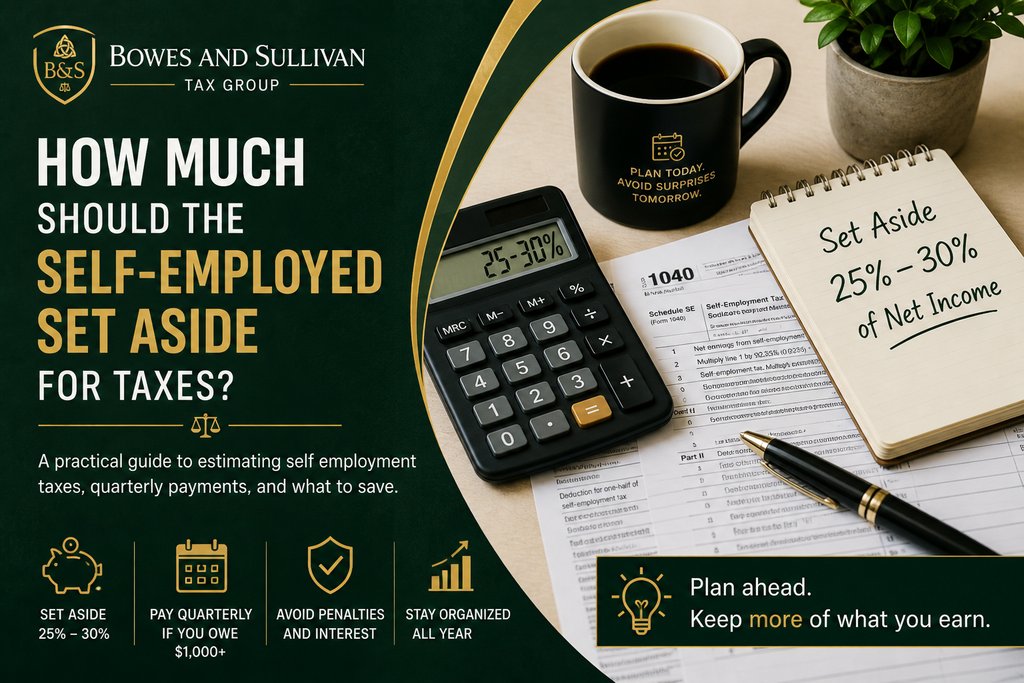
If you are self-employed, taxes are not automatically taken out of your income. Instead, you need to set money aside throughout the year to pay self-employment quarterly taxes and avoid a large bill at tax time.
Setting aside 25% to 30% of your net income is a good general estimate, but your exact amount depends on your tax bracket, state, and deductions. This guide explains how to calculate your taxes and stay on track.
Key Takeaways
- Setting aside 25% to 30% of net income is a useful starting point for most self-employed workers. Some may need closer to 20%, while high earners with few deductions may need 35% or more.
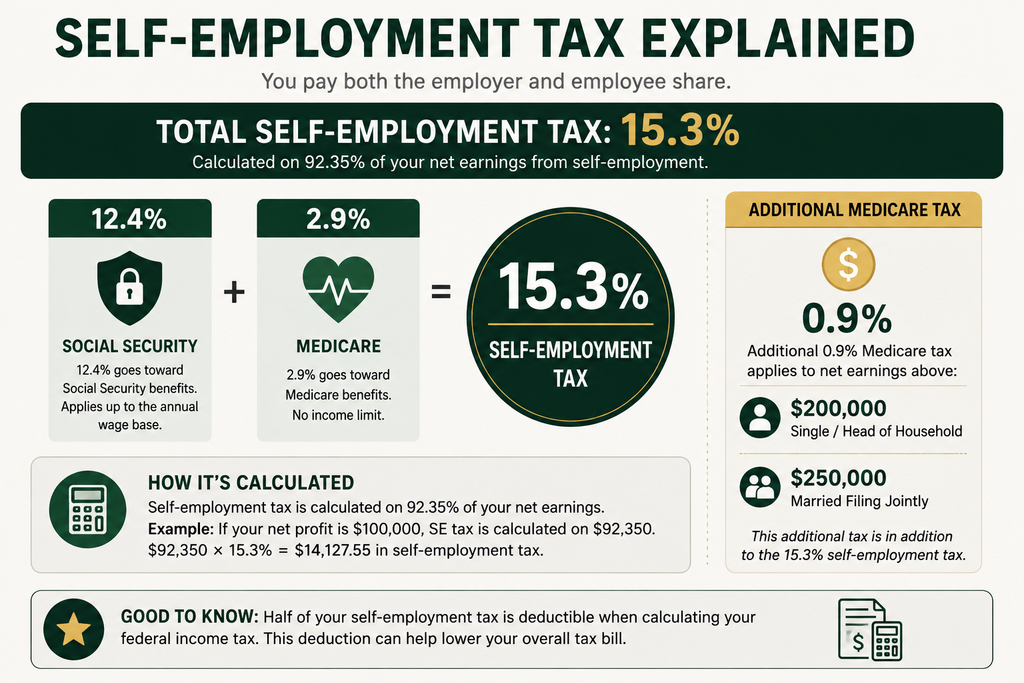
- Self-employment tax is 15.3% of net earnings, covering Social Security and Medicare, and is generally calculated on 92.35% of net profit.
- For 2026, the Social Security portion applies to the first $184,500 of net earnings, while Medicare tax continues beyond that amount.
- Half of the self-employment tax is deductible when calculating income tax, which can lower the overall tax bill.
- The 20% Qualified Business Income (QBI) deduction can also reduce the income tax portion for those who qualify.
- Estimated taxes are generally paid quarterly when the expected tax owed is $1,000 or more after withholding and credits.
- Using the previous year’s actual tax liability can give a more reliable starting point for quarterly payments than relying on a flat percentage alone.
The Simple Answer: 25-30% of Net Income
For most people earning freelancer taxes or 1099 income, setting aside a quarter to a third of net profit covers both taxes in a typical year.
This range works as a starting point because it accounts for two taxes stacking on top of each other. A W-2 employee never has to calculate this combination individually.
Why the percentage feels higher than a regular job
An employee and a self-employed individual can have similar earnings and payroll taxes owed, although that is not the case. An employee is responsible for 7.65% of his or her Social Security and Medicare payments while his or her employer pays the other 7.65% from its accounts.
A self-employed individual fulfills the role of the employer and the employee from the tax perspective. The full 15.3% comes out of their own earnings, with federal income tax added on top. That combination explains why the recommended set-aside percentage looks steep next to a typical paycheck.
When to save closer to 20%, and when to save 35% or more
The 25-30% range is a starting point, not a fixed rule. When figuring out how much to save for self-employed taxes, several factors can shift that number in either direction.
| Situation | Suggested set-aside range | Why |
| Lower income, standard deduction, few dependents | 15-20% | Lower income tax bracket reduces the income tax portion |
| Typical solo freelancer or contractor, moderate deductions | 25-30% | Baseline blend of self-employment tax and income tax |
| High income, minimal deductions, no retirement contributions | 30-35%+ | Higher marginal income tax bracket increases the total |
| Income above $200,000 single / $250,000 married filing jointly | 32-38% | An extra 0.9% Medicare tax applies above these thresholds |
| Significant state income tax | Add 3-10%, depending on state | State tax stacks on top of the federal total |
A part-time freelancer with a low overall tax bracket may genuinely need closer to 15-20%. A high-earning consultant with few deductions and a state tax bill could need 35% or more.
The only reliable way to know what you owe is to run the actual numbers rather than rely on a rough estimate. Consulting with tax relief specialists can help you calculate a more accurate amount and catch potential underpayments before they turn into an unexpected tax bill.
What You’re Actually Saving For
The set-aside percentage is not one tax. It is a combined estimate covering three obligations that all come due at once.
Self-employment tax: 15.3% on your net earnings
This is the Social Security and Medicare tax that a traditional employer would otherwise split with an employee.
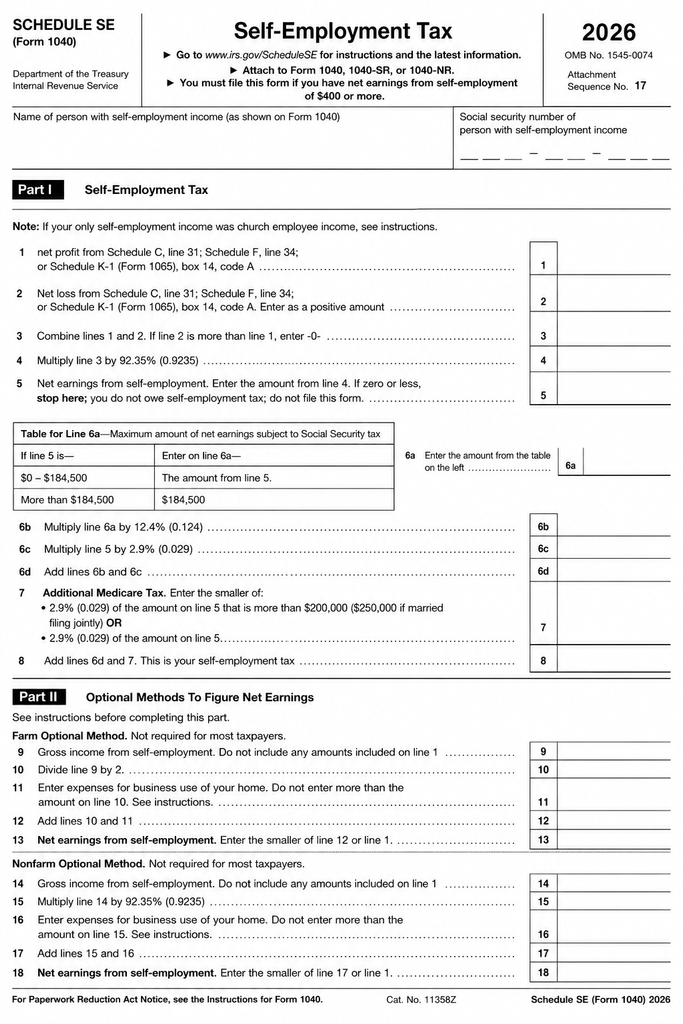
Self-employed individuals pay the entire 15.3% themselves, calculated on 92.35% of net earnings, using Schedule SE.
Federal income tax at your bracket
Net profit from self-employment is also subject to ordinary federal income tax. Rates run from 10% to 37%, depending on total taxable income and filing status.
This is calculated after business deductions, and after the deductible half of self-employment tax reduces adjusted gross income.
State and local taxes most people forget
Federal obligations get the most attention, but most states also tax self-employment income. Some cities and counties add their own local income tax on top.
Anyone budgeting only for federal taxes will come up short in a state with its own income tax. Check the specific state and local rules before finalizing a set-aside percentage.
| Keep your tax savings in a separate account from your everyday business cash. This creates a clear boundary between money you can spend and money you have already set aside for your upcoming tax obligations. |
Managing multiple layers of tax exposure gets harder once a filing has already gone wrong. Here’s how one part of that process actually plays out in practice:
Read More: Tax Debt Settlement: What Realistic Outcomes Actually Look Like
The Self-Employment Tax, Explained
Self-employment tax makes up the largest and least familiar piece of the bill. The self-employment tax rate for 2026 is 15.3%, so it is worth walking through exactly how that amount is calculated.
The 2026 Social Security wage base of $184,500 and the uncapped Medicare piece
For 2026, the Social Security wage base rose to $184,500, up from $176,100 in 2025, per the Social Security Administration. The 12.4% Social Security portion applies only up to that threshold.
The 2.9% Medicare portion works differently. It applies to all net self-employment earnings, with no ceiling.
High earners above $200,000 (single) or $250,000 (married filing jointly) also owe an Additional Medicare Tax of 0.9% on the excess. That brings the effective Medicare rate to 3.8% above those thresholds.
| Component | Rate | Applies to |
| Social Security | 12.4% | First $184,500 of net earnings (2026) |
| Medicare | 2.9% | All net earnings, no cap |
| Additional Medicare Tax | 0.9% | Net earnings above $200,000 single / $250,000 married filing jointly |
| Total self-employment tax rate | 15.3% (plus 0.9% above thresholds) | Applied to 92.35% of net earnings |
The half you get to deduct, and the $400 filing floor
Self-employment tax kicks in once net earnings reach $400 in a year, even for someone who also holds a W-2 job. The threshold is low by design, so it catches side income too.
There’s a meaningful offset, though. Half of the self-employment tax paid is deductible above the line when calculating income tax. This mirrors the way an employer’s matching contribution would work for a W-2 employee, and it lowers the income tax portion of the total bill.
What Lowers Your Real Tax Bill
The 25-30% guideline assumes a fairly typical deduction profile. Business owners who actively manage deductions often land at the lower end of that range, or below it.
Business deductions and the 20% QBI deduction
Business expenses like office costs, travel, software, insurance, and retirement contributions lower your net profit before taxes are calculated.
Many pass-through businesses can also claim the Qualified Business Income (QBI) deduction alongside standard deductions to further reduce taxable income.
| Good records can make a meaningful difference at tax time. Keep receipts, invoices, mileage records, and other expense documentation throughout the year so you can support legitimate deductions when you file. |
Why “net” income, not gross, is what you’re taxed on
A common early mistake is estimating tax liability from gross revenue rather than net profit. Both taxes on self-employment income and income taxes are calculated based on net profits, which are detailed in the Schedule C form.
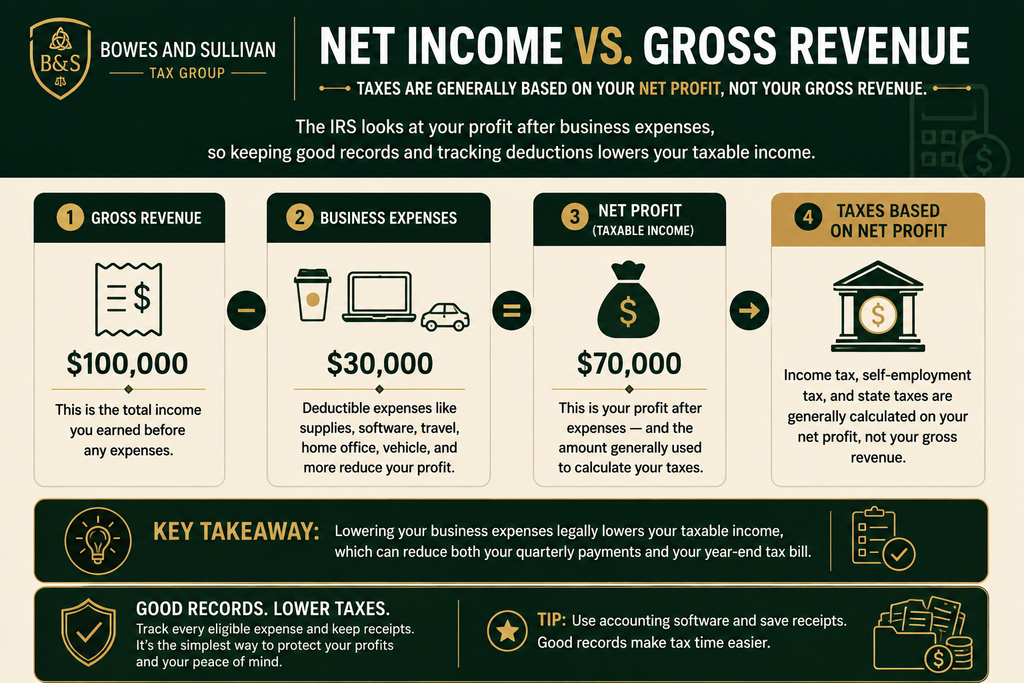
For example, if a taxpayer earned $100,000 and had legitimate costs of $30,000, we don’t pay tax on $100,000, but on $70,000. Keeping track of expenses throughout the year instead of estimating them once at the time of filing assures that the percentage maintained for savers is accurate.
Deductions only help if the underlying filings are accurate and current. When they aren’t, the options for fixing things look like this:
Read More: IRS Currently Not Collectible Status: What CNC Means and How to Qualify
Turning the Percentage Into Quarterly Payments
Setting aside the right percentage only solves half the problem. The IRS wants that money in installments, as income is earned, not once a year.
The 2026 due dates and the $1,000 threshold
The IRS requires estimated payments from anyone who expects to owe $1,000 or more for the year after subtracting withholding and credits. That covers most self-employed taxpayers.
For 2026, the quarterly due dates are:
| Quarter | Period covered | Due date |
| Q1 | January 1 to March 31, 2026 | April 15, 2026 |
| Q2 | April 1 to May 31, 2026 | June 15, 2026 |
| Q3 | June 1 to August 31, 2026 | September 15, 2026 |
| Q4 | September 1 to December 31, 2026 | January 15, 2027 |
Payments are made using Form 1040-ES. Missing a due date, even by a few weeks, can trigger a penalty calculated on the shortfall for that specific quarter.
The periods aren’t equal in length. The second period covers only two months of income but comes due just two months after the first. That catches many first-time filers off guard.
A separate tax account and the pay-yourself-first habit
The most reliable system is a dedicated savings account used only for tax money. Every time a client payment arrives, the set-aside percentage moves out immediately, before it becomes spending money.
This “pay yourself first” approach, applied to taxes, is the single habit that prevents most 1099 quarterly tax shortfalls. Some banks and bookkeeping platforms can automate this transfer, which removes the temptation to skip it during a slow month.
| If your income changes significantly during the year, revisit your tax estimate instead of relying on an earlier calculation. Adjusting your savings and payments can help you stay aligned with what you actually expect to owe. |
A Better Number Than a Flat Percentage
A flat percentage is a useful starting estimate. It isn’t the most accurate way to calculate what’s actually owed each quarter.
Basing payments on last year’s tax or a live projection
The IRS offers a built-in safe harbor. Paying 100% of last year’s total tax liability (110% for higher earners, generally above $150,000 in adjusted gross income) in even quarterly installments generally avoids an underpayment penalty, regardless of the current year’s actual liability. This works well for businesses with stable income year to year.
For businesses with fluctuating or growing income, a live projection is more accurate. Update it each quarter based on actual year-to-date profit, rather than relying on last year’s numbers or a flat percentage.
The 1099 tax set aside percentage should get revisited periodically, not treated as fixed from January through December.
Get Your Tax Savings on Track
Setting aside 25% to 30% of your net income can be a useful starting point, but your actual tax bill depends on your income, deductions, tax bracket, and where you live. Staying on top of your quarterly payments and adjusting what you set aside as your income changes can help you avoid a stressful tax bill later.
Bowes and Sullivan Tax Group helps self-employed taxpayers plan for quarterly taxes, deal with back taxes and penalties, and find practical ways to address tax debt. We work with taxpayers who need help getting their current payments on track as well as those who are already behind.
If you need help with your tax situation, contact us for a consultation and get a plan that fits your income and tax situation.
FAQs
Most self-employed workers should reserve 25% to 30% of net income. Lower earners in a lower tax bracket may only need 15-20%. High earners with few deductions, or income above the Additional Medicare Tax thresholds, may need 35% or more.
Yes, and this threshold catches a lot of people off guard. Net earnings of $400 in a year is all it takes, and having a W-2 job on the side doesn’t change that. The IRS treats freelance income, gig work, or a small side shop as its own separate stream once it crosses that line, on top of whatever’s already being withheld from your paycheck.
You can use Form 1040-ES to pay estimated taxes quarterly online at the IRS payment portal, by phone, through the IRS2Go app, or by mail. Payments are due on April 15, June 15, September 15, and January 15 of the following year.
Not necessarily. The 25-30% baseline generally reflects federal self-employment tax and federal income tax. Taxpayers in states with their own income tax should add several additional percentage points, depending on the state’s rate.
Options exist even after a shortfall. These include IRS payment plans, penalty abatement petitions for taxpayers with fair cause and, in some situations, an Offer in Compromise. Generally, working with tax relief specialists sooner, before the debt has grown or enforcement action has started, can lead to a better conclusion.