
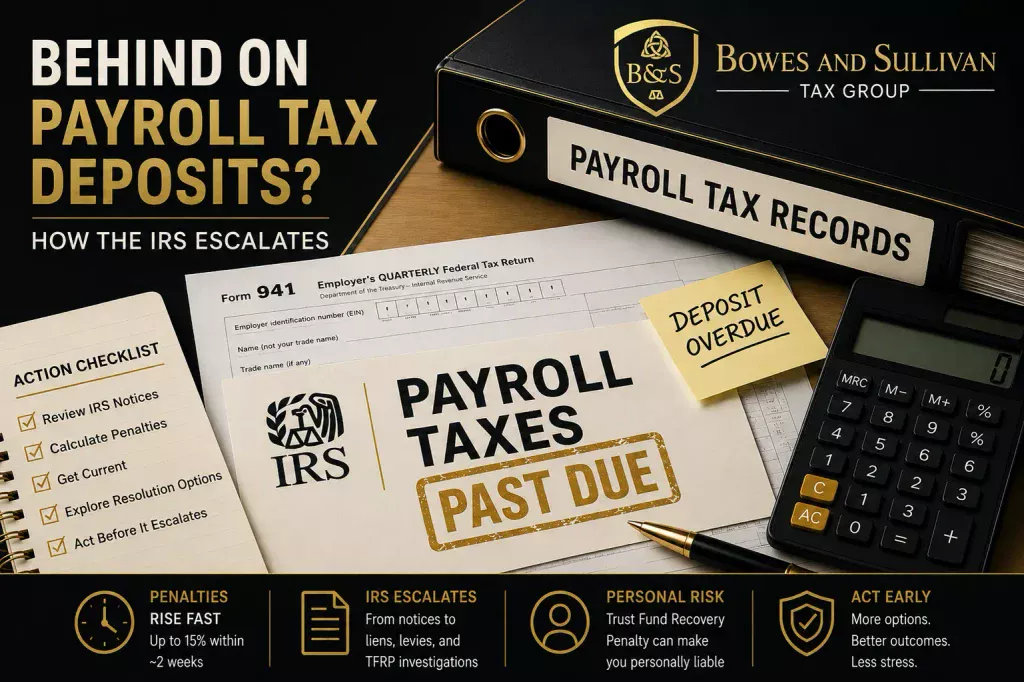
Falling behind on payroll taxes can become serious faster than many business owners expect. A missed payroll tax deposit may begin as a cash-flow problem, but continued nonpayment can lead to IRS collection action and, in some cases, personal liability for responsible individuals. Understanding how the process works can help you recognize the warning signs early.
Payroll tax debt also follows a different path from ordinary income tax debt. This guide explains how the IRS can escalate the situation, from a missed deposit to a potential Trust Fund Recovery Penalty investigation, and what options may remain available if you act before the situation becomes more difficult.
Key Takeaways
- Payroll taxes withheld from employee paychecks are held in trust for the government. The IRS treats non-payment as misappropriation of someone else’s money, not a simple balance owed.
- Failure-to-Deposit penalties reach their top tier of 15% within roughly two weeks of a missed deposit, and interest compounds daily on top of that.
- An unresolved 941 balance escalates from automated notices to a Revenue Officer, who can file liens, issue levies, and open a Trust Fund Recovery Penalty investigation.
- The Trust Fund Recovery Penalty makes any “responsible person” personally liable for 100% of unpaid trust fund taxes, and that liability is separate from the business entity.
- Closing the business or filing bankruptcy does not erase trust fund tax debt. It follows the individuals the IRS identifies as responsible.
- Getting current and responding early preserves resolution options and keeps the case away from Criminal Investigation.
Why Payroll Tax Debt Is the IRS’s Top Priority
Payroll tax debt is the IRS’s top priority because trust fund taxes consist of money withheld directly from employees’ paychecks that never belonged to the business. The IRS views failing to deposit these funds as a misuse of trust money rather than a simple unpaid tax bill, prompting faster enforcement, higher penalties, and personal liability for responsible individuals.
Trust fund taxes are your employees’ money, not yours
Trust fund taxes are the federal income tax and the employee share of FICA that a business withholds from each paycheck. That money never belonged to the business. It belonged to the employee the moment it was withheld, and the employer’s only role is to hold it briefly and forward it to the Treasury on schedule, a structure the IRS describes directly in its guidance on the Trust Fund Recovery Penalty.
Employees still receive full credit for the withholding when they file, whether or not the employer actually remitted it, which is exactly why the government has no one else to collect from if the business cannot pay.
Why the IRS treats non-payment as theft, not a balance due
The IRS does not categorize a 941 late deposit penalty as ordinary tax debt. It treats non-remittance closer to misappropriation of funds held in trust, and that framing explains why enforcement moves faster and is harsher here than almost anywhere else in the tax code. A business behind on its own corporate income tax gets a slower, more forgiving collection timeline.
A business that fails to deposit withheld payroll taxes does not get that same runway. If returns also go unfiled on top of the unpaid deposits, the case moves even faster, which is why getting unfiled tax returns filed early matters as much as addressing the deposits themselves.
Read More: What Happens If You Have Unfiled Tax Returns
The Failure-to-Deposit Penalties That Stack Up Fast
Once a deposit is missed, the clock starts immediately, and the penalty structure is designed to escalate quickly rather than gradually. Here is how the tiers break down and why the balance grows faster than most owners expect.
The 2% to 15% penalty tiers, within days of a missed deposit
The IRS assesses its Failure to Deposit Penalty under IRC 6656 in four tiers, based entirely on how many calendar days late the deposit is:
| Days Late | Penalty Rate | What Triggers It |
| 1 to 5 days | 2% | Deposit made shortly after the due date |
| 6 to 15 days | 5% | Deposit still outstanding beyond the first week |
| More than 15 days | 10% | Deposit remains unpaid, or any direct payment instead of a proper deposit |
| Within 10 days of the first IRS notice | 15% | Balance still unpaid after the IRS formally demands payment |
These tiers do not stack on top of each other. The rate that applies depends on how late the specific deposit was when it was finally paid, or when the IRS issued its first notice demanding payment, whichever applies. In practical terms, a business can move from a 2% penalty to the full 15% tier in a little over two weeks if the balance goes unaddressed.
| The IRS can reach the top 15% Failure-to-Deposit penalty tier in as little as 16 days after a missed deposit. Very few tax problems escalate this fast, which is exactly why early action changes the outcome so significantly. |
How penalties and daily interest compound on a growing balance
The Failure-to-Deposit penalty is only one part of the bill. Separate failure-to-file penalties (5% per month, up to 25%) and failure-to-pay penalties (0.5% per month, also capped at 25%) can apply if the 941 return itself is late or the balance goes unpaid after filing. Interest, currently around 7% for 2026 according to the IRS’s quarterly interest rate schedule, compounds daily on the entire balance, penalties included.
A business that owes 941 taxes for even one difficult quarter can watch that balance grow substantially within a single filing period, well before any IRS employee has even reviewed the case.
How the IRS Escalates a Payroll Tax Case
Penalties are only the first layer. The bigger risk for a business that has fallen behind is what happens once the case moves from an automated system into the hands of a person with enforcement authority.
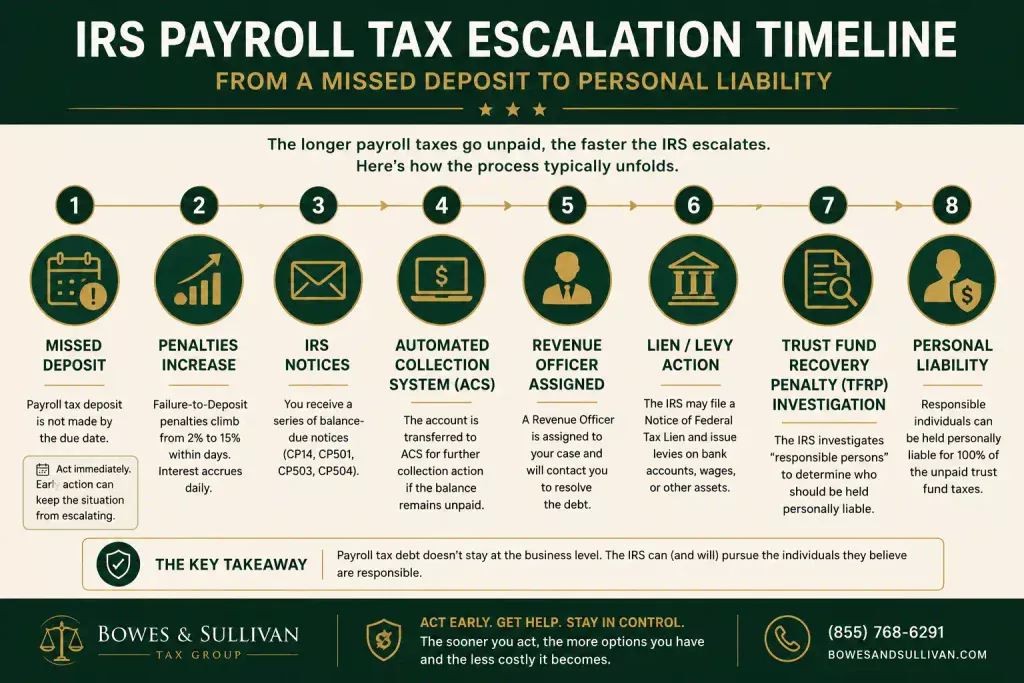
From balance-due notices to the Automated Collection System
A 941 return filed with a balance due, or a Substitute for Return prepared by the IRS if nothing was filed, generates a series of balance-due notices from the IRS’s Automated Collection System. At this stage, the process is still largely computer-driven. Notices arrive on a set schedule, and the business still has room to resolve the issue directly, often without ever speaking to a live IRS employee.
When a Revenue Officer takes over, liens, levies, and summonses
Larger balances, or cases that remain unresolved after the automated notice cycle, get assigned to a Revenue Officer. If you owe 941 taxes, this is where the case becomes personal in a practical sense, even before any Trust Fund Recovery Penalty is assessed.
A Revenue Officer can file federal tax liens against business and personal property, issue levies against bank accounts and receivables, and summon financial records to identify who controls the company’s money. This is also the stage where a formal trust fund recovery penalty investigation typically begins, since the Revenue Officer needs to determine who was responsible for the unpaid deposits.
The danger of “pyramiding” quarter after quarter
Pyramiding means a business accumulates unpaid trust fund tax quarter after quarter without resolving prior periods.
The IRS reads this pattern as strong evidence of willfulness rather than a one-time cash flow problem, and repeated pyramiding can draw the attention of IRS Criminal Investigation, not just the civil collection side. A single rough quarter is a very different case from a business that has let three or four consecutive quarters go unpaid.
Read More: Understanding IRS Penalty Abatement and When You Qualify
The Trust Fund Recovery Penalty: When It Becomes Personal
This is the point where payroll tax debt stops being a business problem and becomes an individual one. Understanding how the penalty works and who it applies to is the most important part of this entire topic.
The 100% penalty under IRC 6672
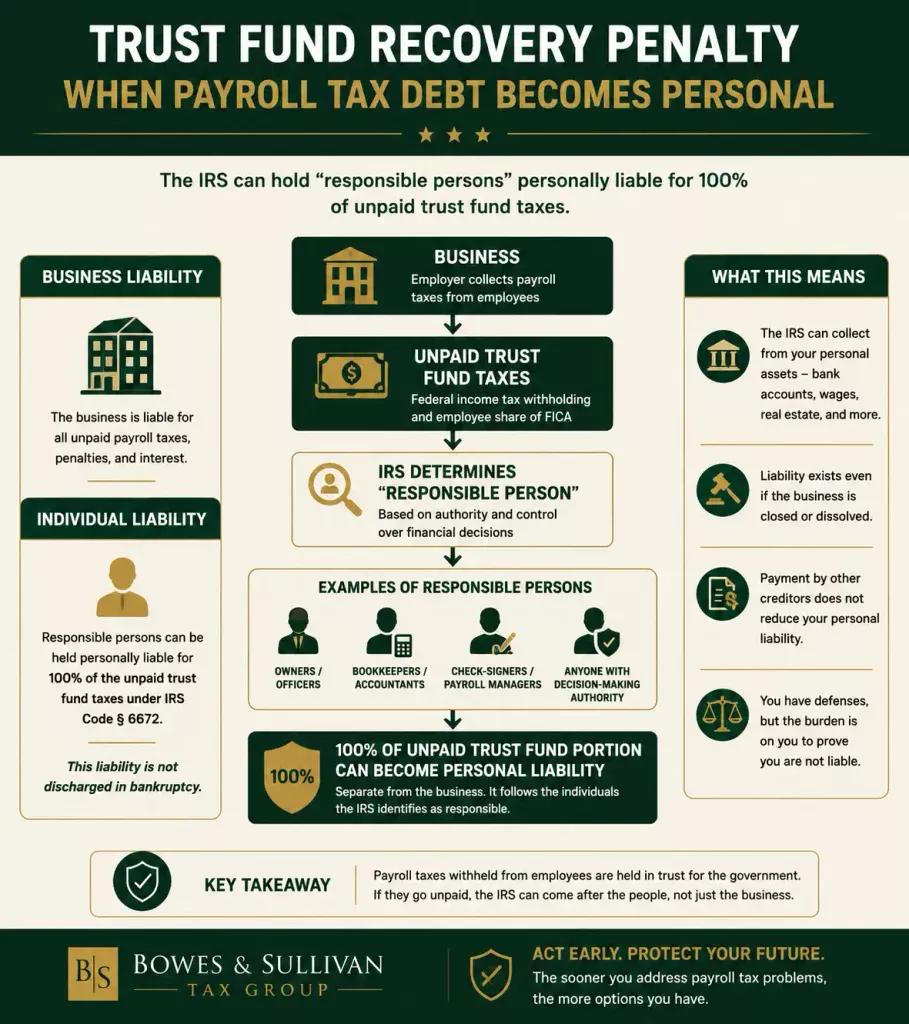
Under IRC 6672, the IRS can assess a penalty equal to 100% of the unpaid trust fund portion directly against an individual, separate from whatever the business itself owes. The IRS’s own explanation is direct on this point: a responsible person who willfully fails to collect, account for, or deposit these taxes can be held personally liable for the full unpaid amount, plus interest. This is a separate, independent assessment against a person.
Who counts as a “responsible person”: owners, officers, bookkeepers, check-signers
The IRS defines a responsible person broadly, and title alone does not determine liability. Anyone with the authority to decide which bills get paid, including owners, corporate officers, bookkeepers, and check-signers, can be named. Even someone without a formal title can qualify if they had real control over which creditors, including the IRS, got paid first.
This is often the most surprising part for business owners: an office manager or controller who signed checks can be pulled into the same investigation as the company’s president.
What “willful” means, and the Form 4180 interview
“Willful” means paying other business expenses like vendors, rent, or payroll while knowing taxes were due; no fraudulent intent is required.
Letter 3585 signals an investigation, and the Form 4180 interview establishes responsibility and willfulness, heavily influencing case resolution.
| Paying employees, vendors, or a landlord instead of forwarding withheld payroll taxes to the IRS can satisfy the willfulness standard, even without any intent to evade taxes. This single point catches many otherwise careful business owners off guard. |
Why the Debt Follows You, Even If the Business Closes
Some tax debts disappear when a business shuts its doors. Trust fund tax debt is not one of them, and understanding why matters for any owner considering closure or bankruptcy as a way out.
Why trust fund taxes survive bankruptcy and dissolution
Because the Trust Fund Recovery Penalty attaches to an individual rather than the business entity, closing the company, dissolving the corporation, or filing personal bankruptcy generally does not eliminate the liability.
Trust fund taxes are treated as a form of misappropriated funds rather than an ordinary debt, which is why bankruptcy courts routinely exclude them from discharge. A business owner who assumes that winding down the company ends the problem is often surprised to find the IRS still pursuing them personally years later.
Read More: Facing an IRS Wage Garnishment? What You Can Still Do
How to Stop the Escalation
None of this is meant to suggest there is no way out. There is, and the earlier a business engages with it, the more options remain on the table.
Getting current and the resolution options that keep the doors open
The first step is always the same: get current on deposits going forward, even before the back balance is resolved, since continuing to fall behind each quarter only adds to the pyramiding problem described earlier. From there, resolution paths typically include installment agreements sized to what the business can actually sustain, IRS penalty abatement requests where reasonable cause applies, and, in select cases, negotiated settlements on the underlying balance.
| Resolution options that exist during the Automated Collection System stage often disappear once a Revenue Officer takes the case and begins a Trust Fund Recovery Penalty investigation. Engaging early keeps more doors open. |
Getting unpaid payroll tax help from someone who has handled Trust Fund Recovery Penalty cases before a Revenue Officer is assigned, rather than after, materially changes what is available.
An Advisor’s Take: Why early representation changes the outcome
In practice, the businesses that come out of a payroll tax problem with the least damage are rarely the ones with the smallest balance. They are the ones who brought in representation before a Revenue Officer opened a Trust Fund Recovery Penalty file, since once that investigation starts, the Form 4180 interview and the responsible-person determination are already in motion and much harder to shape.
A business that owes payroll taxes can consult tax relief specialists during the notice stage, rather than after a lien has been filed, typically has more room to negotiate a manageable resolution and less personal exposure to worry about.
Get Ahead of Payroll Tax Debt Now
Falling behind on payroll taxes triggers a rapid, aggressive collection process. Failure-to-Deposit penalties reach 15% in about two weeks, unpaid balances quickly escalate to a Revenue Officer, and the Trust Fund Recovery Penalty can make owners, officers, or bookkeepers personally liable. Early intervention is critical to managing these outcomes.
At Bowes and Sullivan Tax Group, we assist business owners facing 941 deposit shortfalls, Revenue Officer enforcement, or Trust Fund Recovery Penalty investigations. We help get your business current, negotiate viable IRS resolutions, and represent key personnel during Form 4180 interviews to minimize personal exposure.
If your business owes payroll taxes or has received an IRS notice, act immediately before liens are filed. Contact us today to discuss your options and protect your business.
FAQs
Can the IRS come after me personally for business payroll taxes?
Yes. Through the Trust Fund Recovery Penalty under IRC 6672, the IRS can assess the full unpaid trust fund portion directly against any individual it determines was responsible and acted willfully in failing to collect, account for, or deposit those taxes. This liability exists separately from whatever the business itself owes.
What is the Trust Fund Recovery Penalty?
It is a penalty equal to 100% of the unpaid trust fund taxes, meaning the income tax and employee FICA withheld from paychecks, assessed personally against a responsible individual. It is a separate assessment aimed at collecting funds the IRS considers held in trust, not an added fine on top of the business debt.
What happens if I keep missing 941 deposits?
Missing deposits triggers increasing penalty rates. Repeated missed payments create a pattern called “Pyramiding,” which the IRS views as intentional nonpayment. This speeds up collection actions, leading to Revenue Officer involvement, personal liability investigations, and potentially criminal charges.
Can payroll tax debt lead to criminal charges?
Yes, but usually only in extreme cases. If a business repeatedly fails to pay payroll taxes, uses those funds for other expenses, or intentionally evades payment, the IRS may refer the case for criminal investigation. Responding quickly and making a good-faith effort to pay reduces this risk.
Does closing my business erase the payroll tax debt?
No. Generally, closing, dissolving, or filing personal bankruptcy will not relieve the liability, since the Trust Fund Recovery Penalty is assessed against the liable individual, not the business. The obligation is assigned to whoever the IRS determines to be accountable, even if the business no longer exists.