An LLC or S-Corp can protect business owners from certain business debts, but neither structure guarantees protection from IRS tax debt. Your personal risk depends on the type of tax owed, your role in the business, and whether you controlled unpaid employee taxes.
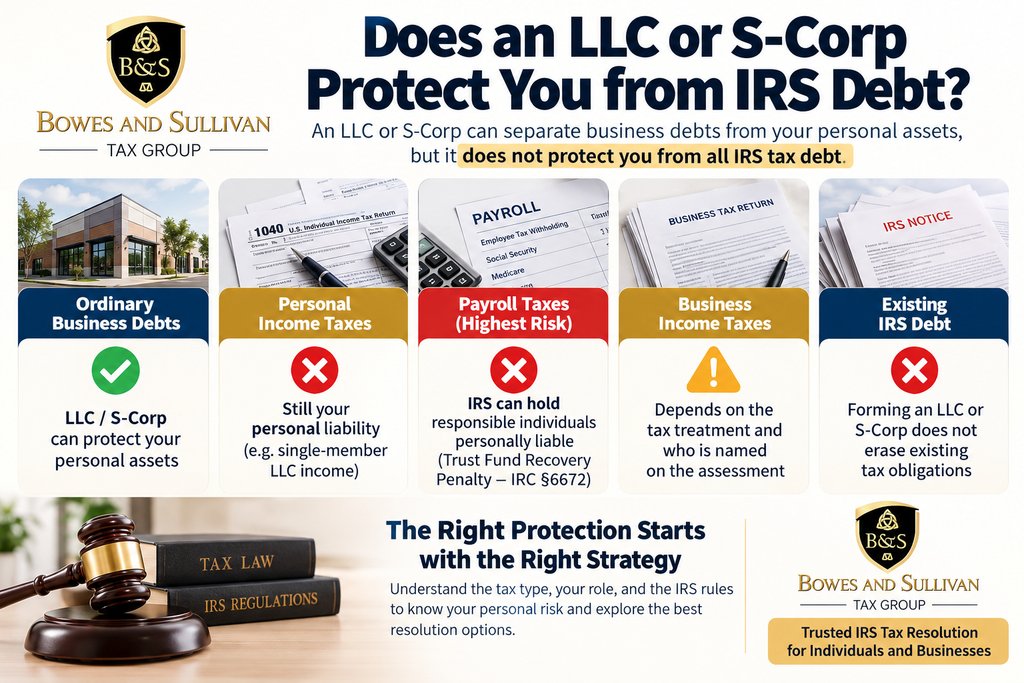
The biggest risk involves payroll taxes. Under Internal Revenue Code Section 6672, the IRS can hold responsible individuals personally liable for certain unpaid trust fund taxes, even when a business operates as a separate legal entity.
Key Takeaways
- LLC protection: An LLC generally separates personal assets from ordinary business debts, subject to legal exceptions.
- S-corp protection: An S-corp does not shield responsible individuals from the Trust Fund Recovery Penalty.
- Payroll taxes: Employee income tax withholding and the employee share of Social Security and Medicare taxes create serious personal risks.
- Personal income taxes: A single-member LLC’s business income generally flows to the owner’s federal income tax return.
- Existing IRS debt: Forming a new entity does not erase an existing tax balance or defeat a valid IRS collection claim.
The Myth: “My LLC Protects Me From the IRS”
No, an LLC does not protect you from the IRS in every situation. An LLC creates a legal boundary, but federal tax law creates exceptions that can expose owners to personal collection.
An LLC is a limited liability company, a business structure that generally separates its owners from certain business debts. That separation does not cancel taxes the owner personally owes or liability imposed by federal law.
| For example, a business might owe corporate taxes without making its owner personally liable. However, an owner who controls payroll funds and knowingly pays suppliers instead of employee withholding faces a different risk. |
Where an LLC or S-Corp Does Create Some Separation
An LLC or S-Corp can separate business obligations from an owner’s personal obligations, depending on the tax type and the facts. This business structure tax liability distinction matters because the IRS assesses and collects different taxes under different rules.
Ordinary Business Debts Vs. Personal Liability
An LLC generally protects an owner’s personal assets from ordinary business debts solely owed by the company. An S-corporation, or S-corp, is a corporation that elects a special federal tax treatment.
The distinction depends on the debt and the owner’s conduct.
- Business income taxes: The tax treatment determines whether the business or owner owes the tax.
- Personal income taxes: Owners remain responsible for their own individual income tax bills.
- Employer payroll taxes: The business generally owes employment taxes, but federal law can impose personal liability for certain unpaid amounts.
- Personally guaranteed debts: An owner who guarantees a business loan agrees to personal responsibility under that guarantee.
Choosing a structure based only on liability protection can lead to costly mistakes. The right analysis starts with identifying the tax, the taxpayer named on the assessment, and the applicable collection rules.
Where That Protection Breaks Down With the IRS
An LLC or S-corp does not prevent the IRS from pursuing an owner who personally owes tax or qualifies for a statutory penalty. Three issues deserve close attention.
The Trust Fund Recovery Penalty and “Responsible Persons” (IRC 6672)
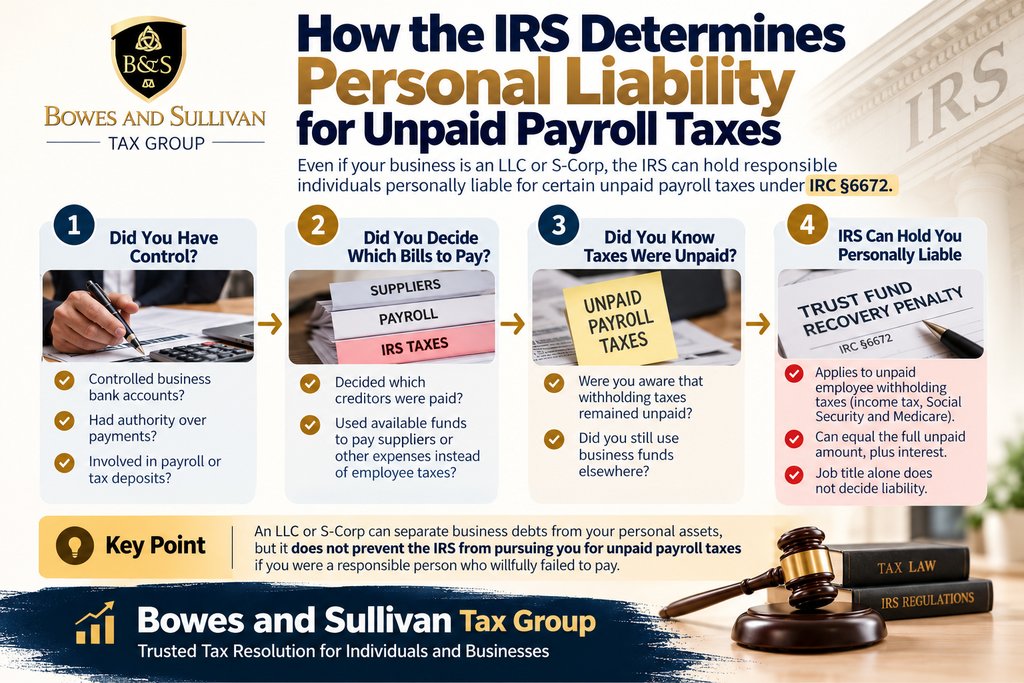
The trust fund recovery penalty is a federal penalty that holds responsible people personally liable for certain unpaid taxes withheld from employees. Under Internal Revenue Code Section 6672, the IRS must establish responsibility for collecting or paying the taxes and willful failure to pay them.
The penalty can equal the full unpaid trust fund amount, plus interest.
A responsible person is someone with sufficient authority over business funds or tax payments. Job title alone does not decide liability.
The IRS can consider whether someone:
- Controlled business bank accounts or payment decisions.
- Decided which creditors received payments.
- Had authority over payroll or tax deposits.
- Knew withholding taxes remained unpaid but used available funds elsewhere.
| Example: A company owes $40,000 in employee withholding taxes. Its owner directs available cash toward suppliers instead of paying those taxes. If the IRS establishes the legal requirements, the owner can face personal liability for the unpaid trust fund amount. |
This is why S. Corp’s IRS debt requires more than a review of the company’s tax return. The IRS examines who controlled payments and what that person knew.
Disregarded Entities And Single-Member LLCs
A single-member LLC is generally a disregarded entity for federal income tax purposes unless it elects corporate treatment. This means the owner usually reports business income and expenses on their own federal income tax return.
The distinction is important:
- The owner’s business income generally affects their personal income tax.
- An LLC with employees remains a separate taxpayer for federal employment tax purposes.
- An LLC’s state-law protection does not erase the owner’s personal income tax obligations.
The IRS explains these separate rules in its guidance on single-member LLCs.
Personal Guarantees, Commingling, and Piercing the Veil
Commingling is mixing personal and business money in a way that ignores the separation between the two. Piercing the corporate veil is a legal process that can allow creditors to pursue owners when applicable legal standards are met.
Keep separate bank accounts, record business transactions, and document payments to owners. A personal guarantee also creates direct contractual liability, regardless of the LLC’s normal protection.
These issues affect business structure tax liability, but they do not automatically make every business tax debt personal. The IRS still needs a valid legal basis to collect from an owner.
Payroll Taxes: The Biggest Personal-Liability Trap
Payroll taxes create one of the clearest paths to personal liability for business owners. The risk exists even when an LLC or S-corp operates properly under state law.
Why Unpaid Form 941 Trust-Fund Taxes Follow The Owner Personally
Form 941 is the quarterly federal tax return employers use to report wages, federal income tax withholding, and Social Security and Medicare taxes. Its trust fund portion includes employee income tax withholding and the employee share of Social Security and Medicare taxes.
Employers collect these amounts from workers and must send them to the IRS. When they fail, the trust fund recovery penalty can apply to each responsible person who willfully fails to pay.
The IRS distinguishes trust fund taxes from the employer’s own share of employment taxes. The Trust Fund Recovery Penalty applies to the unpaid trust fund portion, not automatically to every dollar of payroll tax debt.
For businesses facing payroll tax liability, missed deposits and missed Form 941 filings demand prompt attention. Filing a return does not pay the balance, and paying other creditors first can increase personal risk.
An S-corp does not change these rules. The IRS also treats shareholder-officers who perform more than minor services and receive compensation as employees for employment tax purposes.
What Business Owners Can Actually Do About IRS Debt
Business owners should identify the debt, restore tax compliance, and review available resolution routes before collection action escalates. A company cannot solve every IRS problem by changing its legal structure.
Getting The Business Into Compliance
Start by collecting the records needed to establish what the business owes and who may face personal liability.
- Collect IRS notices: Identify each tax period, balance, penalty, and response deadline.
- Review tax returns: Gather Forms 941, payroll records, bank statements, and proof of tax deposits.
- Check the assessment: Compare the IRS balance with filed returns and payment records.
- File missing returns: Address outstanding filing duties, including missed Form 941 filings.
- Protect current compliance: Make required current payroll deposits while reviewing older debts.
In our practice, a key question is whether the IRS has correctly identified the responsible person and calculated the unpaid trust fund amount. That review helps distinguish a business debt from a proposed personal assessment.
Resolution Options When You Are Personally On The Hook
The best route depends on the debt, the taxpayer’s finances, and the stage of collection. Owners should review options for resolving unpaid payroll tax debt before agreeing to a payment arrangement.
Possible routes include:
- Installment agreement: Pay an eligible tax balance over time under an approved plan.
- Offer in Compromise: Settle eligible tax debt for less than the full amount when IRS rules permit.
- Penalty review: Request relief when the facts and applicable rules support it.
- Appeal rights: Challenge an eligible proposed assessment or collection action within the applicable deadline.
- Collection review: Assess whether an IRS tax lien or a levy is proper and whether relief is available.
An expert tax professional can help challenge an IRS tax assessment when records support a valid dispute. The goal is to identify which assets the IRS can legally seize, preserve applicable appeal rights, and choose a workable resolution.
An Advisor’s Take: The Entity Is Not the Shield Owners Think It Is
The strongest protection comes from understanding which taxpayer owes the debt and why. An LLC or S-corp helps establish legal separation, but it cannot override federal tax law.
For S-corp IRS debt, the critical question is whether the assessment belongs to the corporation or whether the IRS has a legal basis to assess an individual. The same principle applies to LLC payroll tax liability.
We recommend reviewing payroll controls before a business reaches a cash crisis. Employee withholding should never become a source of working capital. Once funds run short, paying suppliers instead of trust fund taxes can create personal exposure.
How Bowes and Sullivan Tax Group Help Business Owners Resolve IRS Debt
Bowes and Sullivan Tax Group provides nationwide IRS tax resolution services for individuals and businesses. Our team includes former IRS agents, tax attorneys, CPAs, and Certified Tax Resolution Specialists, with more than 150 years of combined experience claimed by the firm.
We help business owners address the specific risks discussed in this article through:
- Payroll tax case reviews: We examine unpaid employment taxes, proposed responsible-person assessments, and supporting records.
- IRS notice analysis: We identify the tax periods, response deadlines, and collection steps affecting your business.
- Compliance support: We help address missing returns and incorrect filings that complicate tax resolution.
- Assessment disputes: We review whether the IRS has correctly calculated the debt and identified the responsible person.
- Resolution planning: We assess eligible payment plans, settlement routes, penalty relief, and appeal options.
- Collection representation: We work with the IRS on appropriate relief involving liens, levies, and other collection actions.
Our focus is to address the underlying tax problem rather than offer a temporary fix. Learn more about our IRS tax resolution services.
If payroll tax debt threatens your business or personal finances, contact Bowes and Sullivan Tax Group for a case evaluation. We can review your circumstances and explain which resolution options fit your situation.
Conclusion
An LLC or S-corp can provide meaningful legal separation, but it does not guarantee protection from IRS tax debt. Personal liability depends on the tax involved, the owner’s reporting obligations, and any statutory grounds for an individual assessment. Payroll withholding deserves special care because the Trust Fund Recovery Penalty can reach responsible people who willfully fail to remit employee taxes.
Owners should review IRS notices, verify assessments, and address missing filings before collection escalates. Bowes and Sullivan Tax Group helps business owners assess personal exposure and pursue suitable tax resolution options based on their records and circumstances.
FAQs
Yes, when you personally owe the tax, qualify for the Trust Fund Recovery Penalty, or face another valid legal basis for collection. An LLC does not guarantee immunity.
No. S corp IRS debt can involve personal liability when the IRS establishes that an individual was responsible for trust fund taxes and willfully failed to pay them.
No. Forming an LLC does not erase existing tax obligations or prevent collection against assets already subject to a valid tax claim.
A responsible person has sufficient authority over tax collection or payment decisions. The IRS examines actual duties, financial control, and conduct, not job title alone.