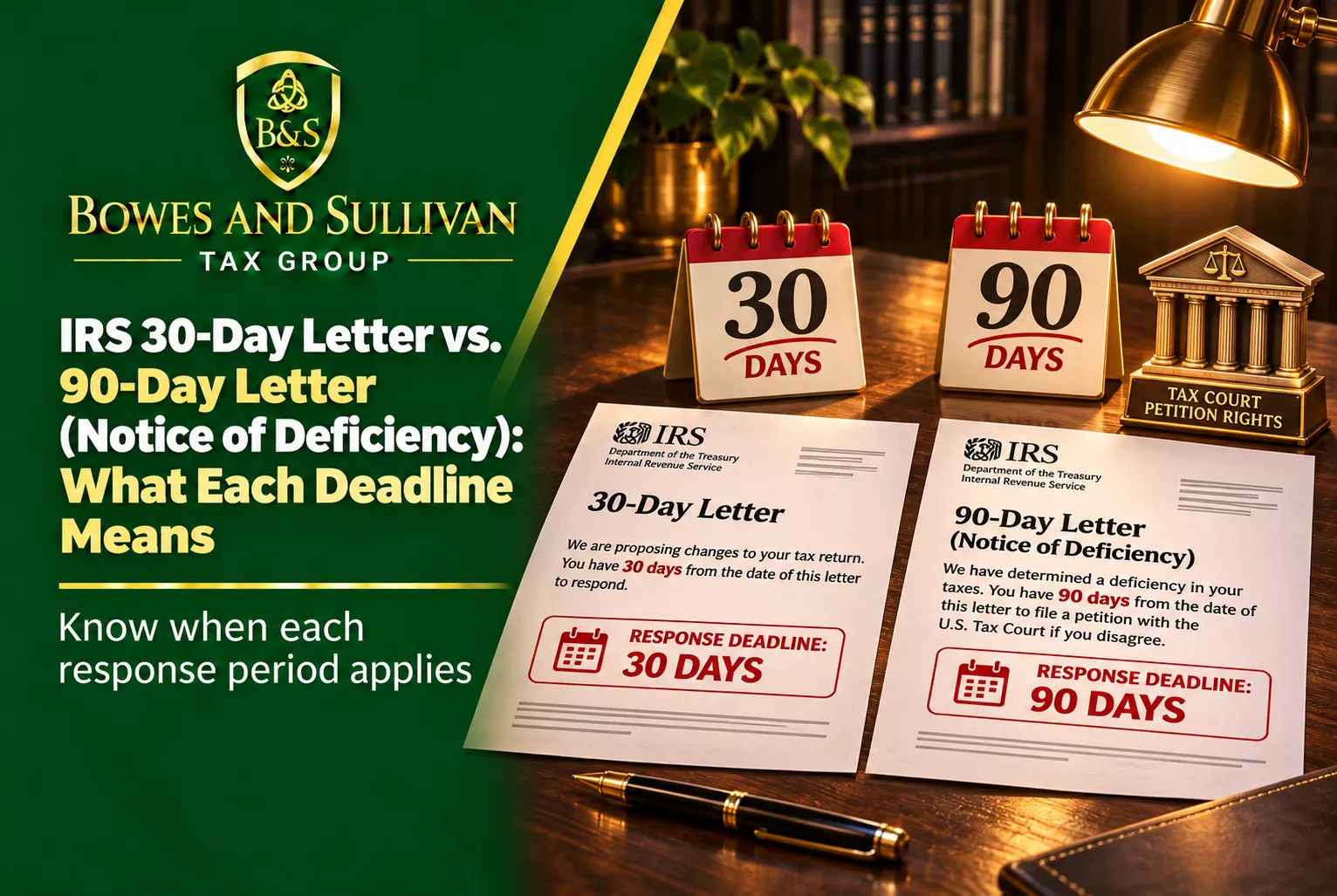
If you requested a tax extension in April but still haven’t finished your return, the October 15 tax deadline is fast approaching. For most taxpayers who filed Form 4868 by April 15, 2026, October 15 is the final date to file a 2025 individual tax return without a late-filing penalty. Some taxpayers qualify for a later deadline, which we’ll cover below.
An extension gives you more time to file your return, not to pay your tax. Any tax you owed was still due on April 15, so interest and the late-payment penalty may already have been accruing. If you don’t think you’ll meet the October 15 deadline, this guide explains what you can do now, how filing and payment penalties differ, how interest adds to what you owe, what the IRS’s new automatic penalty relief means, and what happens if you miss the deadline.
Key Takeaways
- The IRS extension to October 15 is just a filing date change. As of April 15, 2026, the tax was still outstanding.
- Interest and the 0.5% per month failure-to-pay penalty accumulate from April 15, even for taxpayers with a valid extension.
- Filing by October 15 avoids the failure-to-file penalty, which is 5% of the unpaid tax every month, up to a maximum of 25%.
- If a return is filed more than 60 days late, the minimum penalty is the lesser of $525 or the amount of the unpaid tax.
- Interest is 7% per year for the quarter that starts October 1, compounded daily.
First, the One Thing Most People Get Wrong About Extensions
An extension gives you more time to file your tax return, but not more time to pay. Confusing the two can lead to unexpected penalties and interest on any unpaid balance.
An extension gives you until October 15 to file, not to pay
Using Form 4868 gives taxpayers an additional half year to file their tax returns. This means they would have until October 15 instead of April 15 to file their 2025 returns.
However, the IRS has explicitly stated that filing an extension does not extend the deadline for paying taxes. Taxes must be paid by the original due date, even when a taxpayer has applied for and received an extension. The instructions also indicate that a taxpayer needs to be able to estimate how much tax would be owed, and understand that the extension may be invalidated if the estimate does not appear reasonable.
Why your balance has been accruing penalties and interest since April 15
Interest on the unpaid amount begins accruing from the due date and continues on a daily basis until it is settled in full. The applicable interest rate is calculated by adding 3 percentage points to the short-term rate set by the Federal Reserve to arrive at the following: for the quarter of April to June, it was 6%, and by July it was adjusted to 7%. This rate remained in effect for the next quarter.
The penalty for making late payments starts accruing from April 15 as well. The penalty rate is 0.5% for every month that the debt remains unpaid, to a maximum of 25%. For example, if a taxpayer has an outstanding balance of $6,000 since March, then the penalty will accrue to 3% of that amount, which is equal to $180 by October 15, which is before the interest is taken into account.
| A taxpayer who paid at least 90% of the total 2025 tax by April 15, through withholding, estimated payments, or a payment with Form 4868, and pays the rest with the return is treated as having reasonable cause for the late-payment penalty during the extension period. Interest still applies to any part that was paid late. |
The October 15, 2026 Deadline and the Special Cases That Change It
For most people, October 15 is the outer limit. Three groups have different dates: people in federally declared disaster areas, members of the military serving in combat zones, and citizens or residents living abroad. Confirming which rule applies takes a few minutes and can change the whole plan.
Disaster-area, military and combat-zone, and taxpayer-abroad deadlines
| Situation | Filing deadline | Payment and interest |
| Federally declared disaster area | Postponed to a date the IRS sets for the area | Filing and payment are both postponed for affected taxpayers |
| Combat zone service | At least 180 days after leaving the combat zone | Payment is due within the same period |
| Living and working abroad | June 15 automatically, October 15 with Form 4868, December 15 by written request | Interest runs from April 15 on unpaid tax |
Disaster relief depends on location. The IRS has extended deadlines to November 2, 2026 for parts of states like Michigan, and to February 1, 2027 for parts of Nebraska. Check the IRS disaster relief page to confirm your local deadline. Service members in combat zones generally receive at least 180 days after leaving to file and pay.
Taxpayers living abroad automatically get until June 15 and can extend to October 15 via Form 4868, as detailed in Publication 54. They can also request a non-automatic extension to December 15 by submitting a written explanation to the IRS by October 15. Regardless of the extension, interest accrues from April 15.
If You Can’t Finish the Return by October 15
When the return is not ready, wait until every document is in hand. That usually costs more than filing with the records you can support, because the failure-to-file penalty grows every month the return stays unfiled.
File anyway with the numbers you can document, then amend if needed
The IRS requires you to file every return on time, even if you can’t pay right away. Use reliable records like W-2s, 1099s, bank statements, or business logs to complete your return, and skip any figures you can’t back up.
If you locate missing documents later, file Form 1040-X to amend your return for changes in income, deductions, or credits. Minor math errors are usually corrected by the IRS automatically.
How to pull your income data fast with an IRS wage and income transcript
An IRS wage and income transcript shows income reported on Forms W-2, 1099, 1098, and 5498 for the last ten years. You can get it online through an IRS account or request it using Form 4506-T, which IRS Topic 159 notes takes about 10 business days.
The transcript is a starting list. It reflects only what payers reported, so cash income, a form that was never filed with the IRS, and business expenses still have to come from the taxpayer’s own records. Matching the two before filing helps catch missing forms.
If You Can File but Can’t Pay
Filing and paying are separate decisions, and the IRS treats them that way. A return filed on time with a balance still owed costs far less than a return that is not filed at all, so the first move is to file even when the money is not there.
File on time to stop the 5% failure-to-file penalty, then handle the balance
The failure-to-file penalty applies when a return is not filed by the due date, including extensions, so filing by October 15 stops it before it starts. What remains is the 0.5% monthly payment penalty and interest, which cost much less than the 5% monthly filing penalty. Every dollar paid with the return stops interest and the payment penalty on that dollar, and the Form 4868 instructions tell taxpayers to pay as much as they can to limit interest.
Payment options: IRS Direct Pay, a short-term payment plan, or an installment agreement
IRS Direct Pay allows free bank payments without an account. Taxpayers who cannot pay in full can request a short-term plan (up to 180 days with no setup fee) for balances under $100,000, or a monthly installment agreement for balances of $50,000 or less if all required returns are filed.
An approved plan reduces the failure-to-pay penalty from 0.5% to 0.25% per month for on-time filers. Ignoring the balance increases the rate to 1% monthly after a levy notice. Those needing guidance can get help with back taxes.
How the Penalties and Interest Add Up
Three charges apply to a late or unpaid return, and each one runs on its own clock. Putting them side by side shows why the filing date matters more than most people expect.
Failure-to-file versus failure-to-pay, and the combined cap
The filing and payment penalties overlap when a return is filed late and the tax remains unpaid. The table below shows how each charge is calculated, when it starts, and how the two penalties interact in the same month.
| Charge | Rate | Cap | Starts |
| Failure to file | 5% of unpaid tax per month or part of a month | 25% | After the extended due date |
| Failure to pay | 0.5% of unpaid tax per month or part of a month | 25% | April 15, 2026 |
| Both in the same month | 4.5% filing plus 0.5% payment, or 5% combined | Filing penalty stops after 5 months | Months that overlap |
| Interest | 7% a year, compounded daily, for the quarter starting October 1 | None | April 15, 2026 |
When both penalties apply in the same month, the IRS reduces the filing penalty by the payment penalty, so the two together cost 5% per month instead of 5.5%. The filing penalty stops growing after five months, while the payment penalty keeps running until it reaches 25%. At the extreme, that means up to 22.5% for filing plus 25% for payment, or 47.5% of the unpaid tax.
| Example: Take an $8,000 balance with no payments and a return filed on December 1. The last two months carry the combined 5% rate, which is 10%, and the six earlier months carry the 0.5% payment rate, which is 3%. The total is 13%, or $1,040, before interest. |
The $525 minimum penalty and the 7% daily-compounding interest
A return filed more than 60 days late triggers a minimum penalty. For returns due in 2026, it is the smaller of $525 or 100% of the tax owed. For a return due October 15, the 60-day mark falls in mid-December. A taxpayer who owes $300 would pay at most $300, and one with a larger balance pays whichever is higher, the percentage penalty or $525.
Interest is charged on unpaid tax and on penalties, and the rate is 7% a year compounded daily for the quarter that starts October 1. Because it compounds, the real yearly cost is slightly above 7%. The IRS does not generally abate interest, although interest on a penalty comes off when that penalty is removed.
Penalty Relief: What You Can Actually Get Removed
Most penalties on a late return can be removed if the taxpayer qualifies for relief, while interest is much harder to reduce. That makes relief worth pursuing early, since the penalty portion of a late-filed balance can be large.
The IRS’s new automatic penalty relief (AEP) and reasonable-cause relief
The IRS announced the Automatic Exemption from Penalty, or AEP, on July 8, 2026. It applies to original returns beginning with tax year 2025, so it covers the return many people are working on now.
A taxpayer must have not only a record of prompt filing and payment in the last three years, but also no penalties in those years other than the estimated tax penalty, unless the penalty later has been waived for good cause or due to an IRS mistake. When AEP applies, no penalties for failure to file, pay, or deposit are assessed by the IRS.
| AEP is applied when the original return finishes processing. The taxpayer does not apply for it and does not need to respond to the IRS notice that confirms it. Any unpaid tax and interest are still owed. |
During the transition period for AEP, qualifying taxpayers who still receive penalty notices can contact the IRS to request First Time Abate. AEP fully replaces First Time Abate for returns due on or after January 1, 2027.
Taxpayers who do not qualify can request reasonable cause relief by phone or on Form 843 by demonstrating good faith. For larger amounts, a documented IRS penalty abatement request is recommended.
What Happens If You Miss October 15 Entirely
If the October 15 deadline is missed, you still have options, but each month adds cost. A late return is still far better than no return.
Late filing, a possible substitute for return, and the three-year refund deadline
You can still file taxes after October 15. Submit a past-due return using the same standard methods, unless an IRS notice specifies otherwise. However, a late tax return after an extension incurs the failure-to-file penalty starting October 16, so file as soon as your records allow.
If you don’t file, the IRS may prepare a substitute return that omits entitled deductions and credits, followed by a Notice of Deficiency (CP3219N). You then have 90 days to submit your return or petition the Tax Court before the proposed tax is assessed, which could result in a levy or a federal tax lien.
Having multiple unfiled years complicates matters because setting up a payment plan requires all past returns to be submitted first. Additionally, the IRS will hold pending tax refunds, and self-employment income won’t be credited toward Social Security benefits until unfiled returns are resolved.
| A refund is lost if the return is not filed within three years of its due date. The same three-year limit applies to credits such as the Earned Income Credit. |
Read More: IRS Statute of Limitations on Unfiled Tax Returns: Expert Guide
An Advisor’s Take: File First, Then Solve the Money Problem
In the cases we handle, the pattern repeats. People stop filing because they cannot pay, and the delay creates a larger bill than the tax ever was. Our advice is to file first and solve the money problem second.
Why filing immediately is the highest-value move, even with no payment
Filing immediately does more than stop a single penalty. In practice, it accomplishes five key goals at once:
- It stops the 5% monthly failure-to-file penalty from growing.
- It shows the IRS the correct tax, which removes the reason for a substitute return.
- It makes a payment plan possible, since the IRS requires all returns to be filed first.
- It keeps a refund claim alive inside the three-year window.
- It lets penalty relief such as AEP be applied when the return is processed.
Payment comes second, and it is much easier to manage once your return is filed. With a filed return, your exact balance is known, making it easy to set up a payment plan or request penalty relief. If you owe a large amount, have multiple unfiled years, or have received IRS notices, tax relief specialists can review your account, confirm eligible penalty removals, and negotiate an affordable payment plan.
Read More: When To Call A Tax Relief Specialist: What To Ask and How They Can Help
Get Your Filing and Payment Plan on Track
File your return first to stop the 5% monthly penalty, even if you can’t pay immediately. Then, set up a payment plan and request penalty relief if eligible. Total costs depend on your unpaid tax, filing delay, and past three years of compliance history.
At Bowes and Sullivan Tax Group, we assist taxpayers whether within the extension window or already past the deadline with filing past-due returns, handling IRS notices, requesting penalty relief, and arranging back-tax payments.
Contact us for a consultation to create a tailored strategy for your return, balance, and timeline.
FAQs
The failure-to-file penalty is 5% of the unpaid tax for each month or part of a month, up to 25%. In months when the payment penalty also applies, the filing portion is reduced to 4.5%. A return more than 60 days late has a minimum penalty of $525 or 100% of the tax owed, whichever is less. Penalty relief may reduce or remove it.
No. The tax was due on April 15, and interest and the late-payment penalty start from that date. The one exception in the Form 4868 instructions is the 90% rule, where a taxpayer who paid at least 90% of the total tax by April 15 and pays the rest with the return is treated as having reasonable cause for the late-payment penalty.
There is no failure-to-file penalty when no tax is owed, because the penalty is calculated on the tax that remains unpaid after payments and credits. The refund itself still has a deadline. The taxpayer must file within three years of the return due date to claim it, and refunds are held while any past-due return is outstanding.
Yes, as long as every required return has been filed. The IRS offers a short-term plan of up to 180 days with no setup fee and monthly installment agreements for longer terms. Interest and penalties continue while a plan is active. The reduced 0.25% payment-penalty rate applies only when the return was filed on time.
Both situations can move the deadline. Taxpayers in a federally declared disaster area should check the IRS disaster relief page for the postponed date in their county. Taxpayers abroad have an automatic June 15 date, an October 15 date with Form 4868, and a discretionary December 15 date by letter. Interest still runs from April 15.