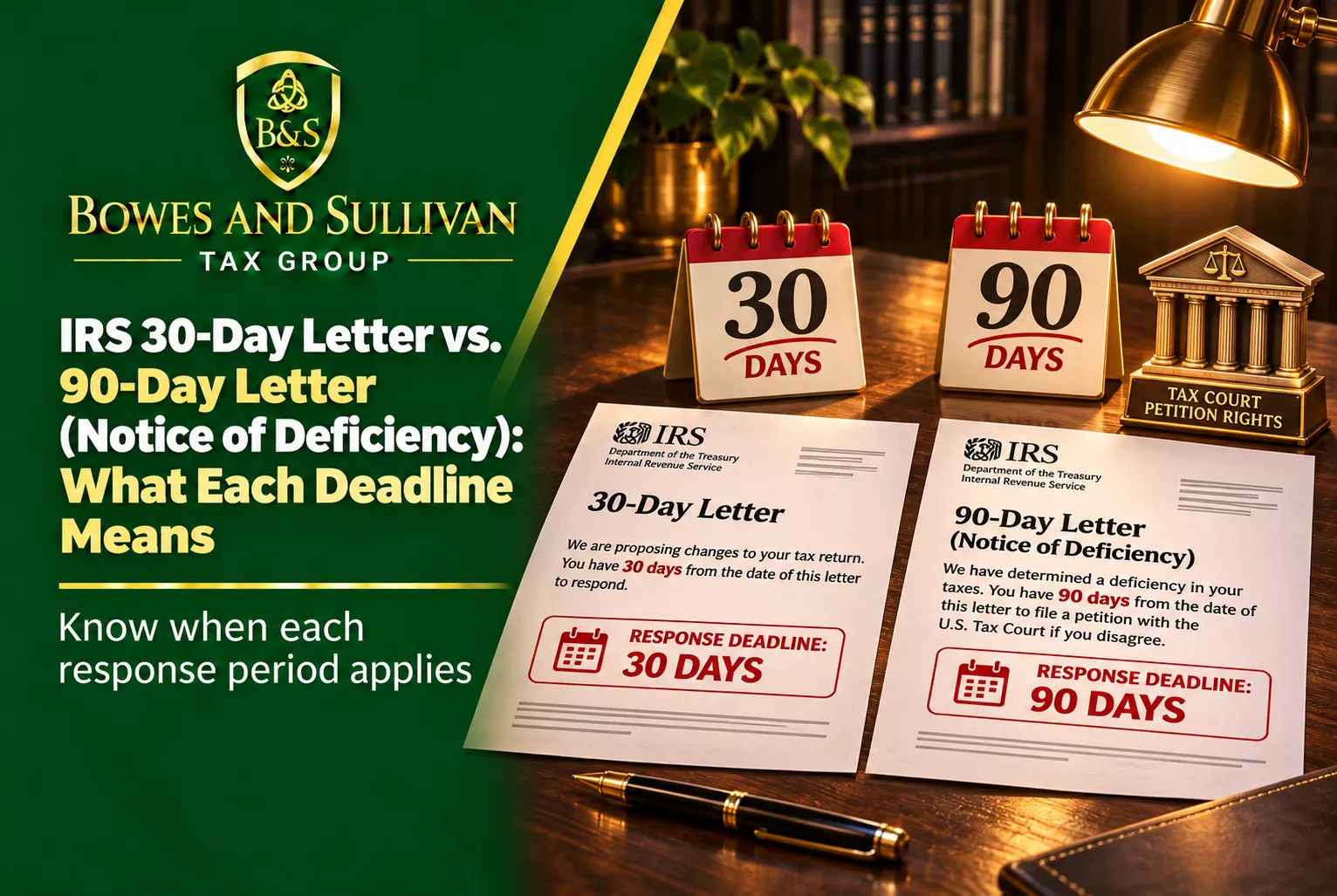
An IRS 30-day letter gives you an opportunity to challenge proposed audit changes through the IRS’s administrative appeal process. An IRS 90-day letter is a formal legal notice that gives you a limited period to challenge a proposed tax deficiency in the U.S. Tax Court without paying the disputed tax first.
However, missing the 30-day deadline does not automatically eliminate your right to petition the court. This guide explains how each deadline works, where to send your response, and what you can do if you miss the deadline.
Key Takeaways
- 30 days: Generally, the period to request an administrative appeal after receiving a qualifying audit letter.
- 90 days: Generally, the period to petition the U.S. Tax Court after the IRS mails a statutory notice of deficiency.
- 150 days: The extended period generally applies when the notice is addressed to a person outside the United States.
- No prepayment required: You generally do not have to pay the disputed tax before requesting an administrative appeal or filing a timely Tax Court petition.
- Different procedures: An IRS appeal and a Tax Court petition are separate legal processes.
What Is the Difference Between an IRS 30-Day Letter and a 90-Day Letter?
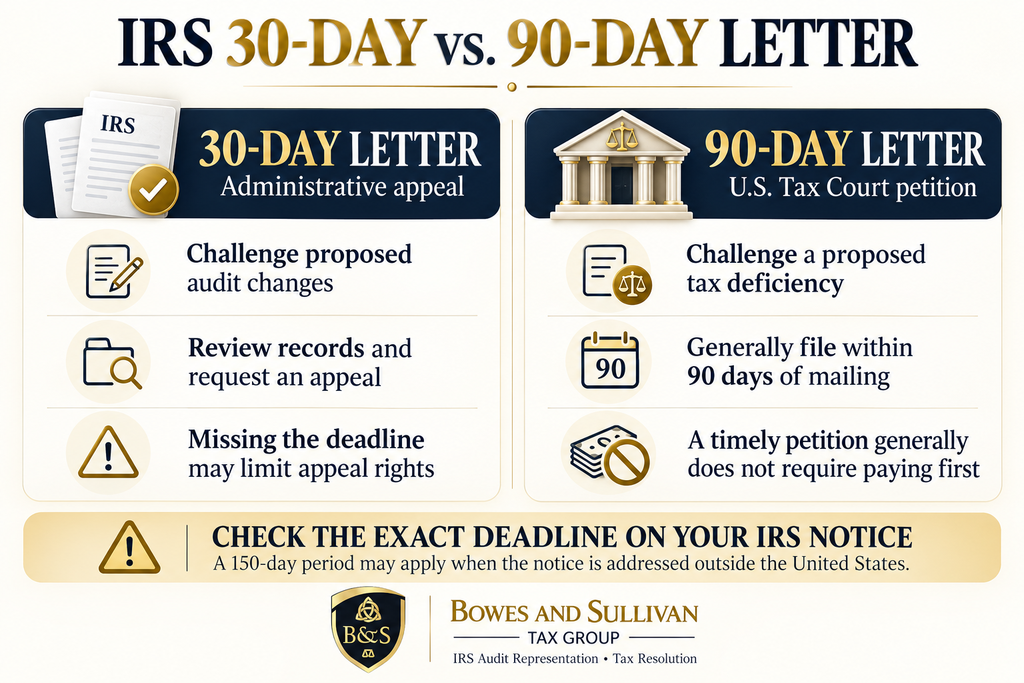
An IRS 30-day letter offers an administrative review of proposed audit changes. An IRS 90-day letter gives you the right to challenge a proposed deficiency in court before paying the disputed amount.
The following table compares their purpose, deadlines, and consequences.
| Feature | 30-day letter | 90-day letter |
| Purpose | Request review by the Independent Office of Appeals | Challenge a proposed tax deficiency in court |
| Deadline | Generally 30 days from the letter date | Generally 90 days from the notice mailing date |
| Where to respond | IRS office identified in the letter | U.S. Tax Court |
| Payment required to challenge? | Generally no | Generally no |
| If you miss the deadline | The IRS may proceed toward a notice of deficiency | You generally lose the right to petition the court under that notice |
The table shows a 30-day letter concerns administrative review, while a 90-day letter creates a statutory court-petition deadline. Always follow the instructions and deadline printed on your specific notice.
What Should You Do Within 30 Days of Receiving an IRS 30-Day Letter?
You should review the examination report, gather supporting records, and either accept the proposed changes or request an appeal before the stated deadline.
Review The Examination Report And Identify Disputed Adjustments
The examination report explains which items the IRS proposes to change and why. Compare those changes with your filed return and supporting records.
Focus on:
- Income the IRS believes you did not report.
- Deductions or credits the IRS proposes to remove.
- Business expenses the examiner considers unsupported.
- Calculations that do not match your records.
Start collecting the documents to gather before responding to an IRS audit, including receipts, bank statements, invoices, Forms W-2 or 1099, and relevant tax records.
Decide Whether To Agree Or Request An Appeal
If the proposed changes are correct, follow the agreement and payment instructions in the letter. If you disagree, follow its instructions for requesting an appeal.
Some letters require a formal written protest. Others allow a different response. Check the exact requirements before submitting your request.
The IRS identifies Letter 525 as a general 30-day letter and Letter 915 as an examination report transmittal. Both can provide appeal rights, but not every IRS letter follows the same procedure.
| An important distinction: Missing the deadline on an IRS 30-day letter does not automatically end your right to challenge the proposed tax in court. The IRS may issue a separate statutory notice of deficiency, which creates a new deadline. |
What Should You Do Within 90 Days of Receiving a Notice of Deficiency?
You must file a timely petition with the U.S. Tax Court if you want to challenge the proposed deficiency through that court without paying the disputed tax first.
Calculate The Petition Deadline From The Notice
A tax court petition deadline generally falls 90 days after the IRS mails the notice of deficiency. The notice should state the last date for filing.
Check these details immediately:
- Notice date: Find the date the IRS mailed the notice, not the day you opened your mailbox.
- Final filing date: Check the deadline printed on the notice.
- 150-day exception: This generally applies when the IRS addresses the notice to a person outside the United States. Simply traveling abroad does not qualify you automatically.
- Weekend or legal holiday: The deadline generally moves to the next business day when the last day falls on a Saturday, Sunday, or qualifying legal holiday. Confirm the applicable court rules.
The statutory notice of deficiency is a formal notice of the IRS’s proposed tax assessment. It gives you a legal right to ask the court to review the dispute.
File A Petition With The U.S. Tax Court If You Disagree
A tax court petition deadline is a strict legal deadline. The court generally cannot extend it because you need more time to collect documents or negotiate with the IRS.
To protect your rights:
- Follow the court’s official petition instructions.
- Identify the IRS adjustments you dispute and explain why.
- Include the required copy of the notice, with sensitive identification details removed as instructed.
- File electronically through the court’s DAWSON system or use an accepted paper-filing method.
- Keep proof of timely filing.
The court’s standard petition filing fee is $60, although you can request a waiver if you qualify.
Do not send your petition only to the IRS. File it with the U.S. Tax Court. Asking the IRS to reconsider its findings does not extend the court deadline.

What Happens If You Miss the 30-Day or 90-Day IRS Deadline?
Missing a 30-day deadline usually affects your administrative appeal opportunity. Missing a 90-day deadline generally removes your right to petition the Tax Court under that notice.
The consequences differ:
- Missed 30-day deadline: The IRS may continue processing the case and issue a notice of deficiency. Check your case status and watch for further notices.
- Missed 90-day deadline: The IRS can generally assess the proposed tax after the petition period expires, subject to applicable legal rules.
- Deadline already passed: You may still have other remedies, depending on whether the IRS assessed the tax and your case history.
Possible options include audit reconsideration or an eligible refund claim after payment. These remedies have separate requirements and do not restore the missed Tax Court deadline.
Can You Still Challenge the IRS After the 90-Day Deadline?
Yes, you may have other options after missing the Tax Court petition deadline, but you generally cannot recover the lost right to petition under that notice.
Take these steps promptly:
- Contact the IRS: Confirm whether the proposed tax has been assessed and whether collection activity has started.
- Consider audit reconsideration: The IRS may review an assessment when you have new evidence or did not previously respond to the examination.
- Review refund claim rights: After paying the tax, you may qualify to file a refund claim within the applicable deadline.
- Consult a tax professional: Ask for a review of the notice, assessment status, and remaining legal options.
The IRS generally cannot extend the statutory Tax Court petition deadline simply because you request additional time.
How Should You Decide Between an IRS Appeal and a Tax Court Petition?
Choose the process based on the letter you received and the stage of your case.
- You have a 30-day letter: Consider requesting an administrative appeal if you disagree with the proposed changes and have evidence supporting your position.
- You have a 90-day letter: Consider filing a timely Tax Court petition if you want to challenge the deficiency without paying it first.
- You agree with the changes: Follow the notice’s instructions for accepting the proposed adjustments and resolving any amount due.
Your IRS tax appeal options depend on the specific notice and applicable rules. An administrative appeal and a Tax Court petition are not interchangeable.
How Bowes and Sullivan Tax Group Can Help You Respond on Time
Bowes and Sullivan Tax Group provides IRS audit representation and tax resolution services nationwide. Our team includes former IRS agents, enrolled agents, certified tax resolution specialists, tax attorneys, and certified public accountants.
Our team has more than 150 years of combined experience handling IRS matters. Its services include audit representation, IRS notice responses, and direct communication with the IRS.
We can help you:
- Review your IRS letter and identify the applicable response deadline.
- Examine the proposed adjustments and organize supporting tax records.
- Prepare an administrative appeal when the letter and case facts support one.
- Assess your options when you receive a statutory notice of deficiency.
- Coordinate IRS communications and help develop a response strategy.
- Review your case if you have already missed a deadline.
Our approach begins with your actual notice, tax records, and current IRS case status. We identify the available procedures and explain the next steps before you decide how to proceed. Request a confidential consultation about your IRS audit letter or notice of deficiency.
Conclusion
The difference between an IRS 30-day letter and an IRS 90-day letter determines how you can challenge proposed IRS tax changes and how quickly you must act. A 30-day letter generally offers an opportunity for administrative review. A statutory notice of deficiency gives you a separate, strict deadline to petition the U.S. Tax Court.
Do not assume that contacting the IRS, requesting more time, or gathering additional records will preserve your court rights. Check the date printed on your notice and follow the correct filing procedure.
Bowes and Sullivan Tax Group can help you review your notice, assess your available options, and prepare an appropriate response. Contact us promptly if your deadline is approaching or has already passed.
FAQs
Yes. An IRS 90-day letter is another name for a statutory notice of deficiency, which generally gives you 90 days to petition the U.S. Tax Court.
Yes. You can challenge the proposed deficiency by filing a Tax Court petition within the deadline stated in your notice, generally 90 days after mailing.
You can dispute specific adjustments, but follow the notice instructions and explain which items you contest. Get professional advice before signing an agreement.
No. Responding to an IRS 30-day letter or filing a Tax Court petition does not automatically stop interest from accruing on an unpaid tax balance.