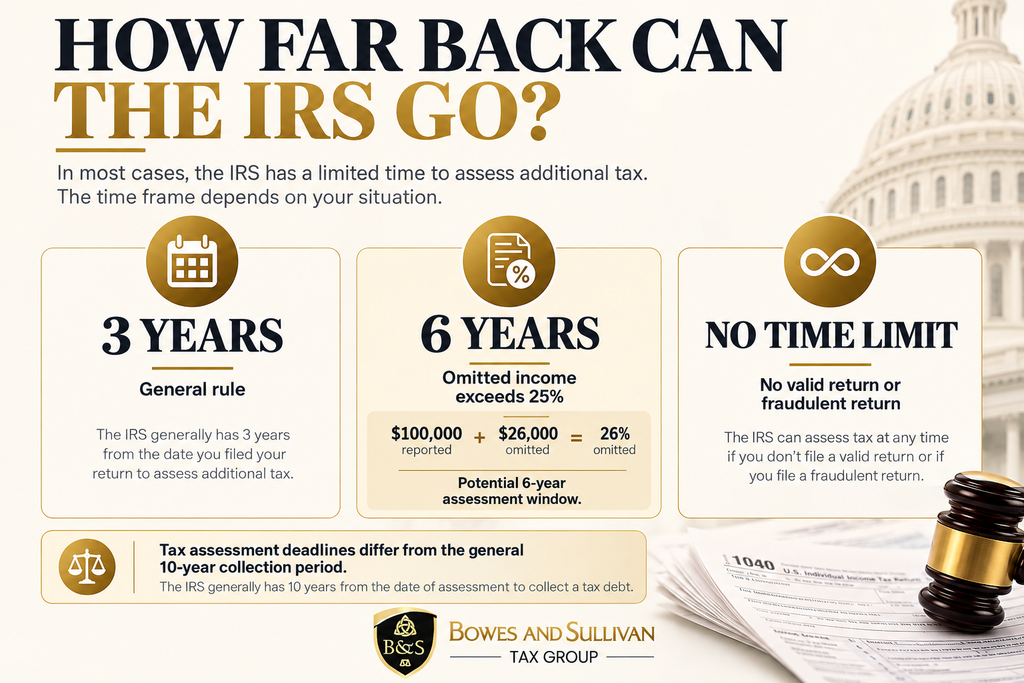
The IRS generally has three years to assess additional tax after you file your federal tax return. However, the deadline extends to six years for certain substantial income omissions. If you never file a valid return or file a fraudulent return to evade tax, the IRS can assess tax without a time limit.
Understanding how far back the IRS can audit you requires more than counting calendar years. This guide explains the three-year rule, six-year rule, unlimited assessment period, recordkeeping requirements, and ways professional representation can help when the IRS questions an older return.
The Short Answer: How Far Back the IRS Can Go
The IRS generally reviews returns within three years, but certain legal exceptions allow a longer period or an unlimited assessment period. The IRS audit statute of limitations sets the deadline for assessing additional tax, not a universal deadline for every IRS action.
The following table compares the main rules under Internal Revenue Code (IRC) Section 6501. The trigger determines which deadline applies, so an older tax year does not automatically qualify as closed.
| Rule | Trigger | Time limit | Practical meaning |
| Three-year rule | Valid return filed | Generally 3 years | Standard assessment window |
| Six-year rule | Qualifying income omission | 6 years | Certain older returns remain open longer |
| Unlimited assessment period | No valid return or fraudulent return | No fixed limit | The usual deadline does not protect that year |
| Extension by agreement | Written consent before expiration | Agreed period | The IRS receives additional assessment time |
The deadline depends on the return’s history and any applicable exceptions. Review the original filing date and relevant IRS records before treating a year as closed.
The 3-Year Rule: The Standard Audit Window (IRC 6501(a))
The three-year rule generally allows the IRS three years to assess additional tax after a valid return’s filing date, subject to special filing-date rules. IRC Section 6501(a) establishes this standard period.
When the Three-Year Clock Starts, and Why Filing Early Does Not Help
A return filed before its original due date generally counts as filed on that due date. A late return generally starts the three-year period on the actual filing date.
| For example, the IRS states that a timely 2021 individual return filed on April 18, 2022, had an assessment statute expiration date of April 18, 2025. A late return filed on October 31, 2022, after its October 17 extended deadline, generally had an expiration date of October 31, 2025. |
An extension to file generally changes the filing deadline, but it does not automatically create a new three-year period starting when you submit the return. A separate written agreement with the IRS can extend the assessment period.
The IRS audit statute of limitations also depends on whether your return qualifies as valid under federal tax rules. An unsigned return does not start the assessment period.
The 6-Year Rule: Substantial Understatement of Income (IRC 6501(e))
The six-year rule gives the IRS additional time when a taxpayer omits qualifying income exceeding 25% of the gross income reported on a return. Certain unreported foreign financial assets also trigger this rule when the statutory conditions apply.
What Counts As A 25% Omission Of Gross Income
The 6-year audit rule applies when omitted gross income exceeds 25% of the gross income stated on the return.
Consider these numbers:
- Gross income reported: $100,000.
- Additional qualifying gross income omitted: $26,000.
- Omission percentage: 26%.
- Potential assessment window: Six years from filing.
Because $26,000 exceeds 25% of $100,000, the six-year rule can apply. An omission of $25,000 exactly does not exceed the threshold, although another exception could still extend the deadline.
Basis Overstatements And Unreported Accounts
The six-year rule covers more than forgotten wages or business receipts. IRC Section 6501(e) treats certain overstatements of unrecovered cost or other basis as omissions from gross income.
Basis is the amount used to calculate taxable gain or loss on an asset. For example, overstating a property’s tax basis can reduce the reported gain when you sell it.
Certain foreign financial assets also trigger a six-year period if the omitted income meets the applicable statutory test and exceeds $5,000. The details matter, so review the type of income, disclosure on the return, and relevant records before deciding whether the extended period applies.
The Unlimited Rule: No Return or a Fraudulent Return (IRC 6501(c))
The IRS can assess tax at any time if you fail to file a valid required return or file a fraudulent return with the intent to evade tax. IRC Section 6501(c) sets out these exceptions to the normal assessment deadline.
Why an Unfiled Return Keeps The Window Open Indefinitely
An IRS audit unfiled return case does not receive the standard three-year protection until you file a valid return. An IRS-created Substitute for Return (SFR) generally does not start that three-year clock.
| For example, if you were required to file your 2018 return but never filed it, the IRS can generally assess tax for that year even in 2026. Filing a valid return starts the normal assessment period, subject to other exceptions. |
The IRS audit unfiled return issue requires careful review of which years remain unfiled and whether the IRS has already assessed tax. Filing overdue returns can establish assessment deadlines, but it does not erase existing tax debt.
When A Preparer’s Fraud Extends The Clock, The Murrin Rule
The 2025 Murrin v. Commissioner decision addressed whether a tax preparer’s intent to evade tax can trigger the unlimited assessment period even when the taxpayer lacked that intent.
On October 17, 2025, the Third Circuit held that the taxpayer’s own intent was not required under IRC Section 6501(c)(1) in that case. The ruling involved fraudulent entries made by a preparer on the taxpayer’s returns.
This is a significant warning for taxpayers who relied on a preparer. However, the decision arose in the Third Circuit, and its application depends on the facts and controlling law. Do not assume every preparer error creates an unlimited assessment period.
Audit Lookback vs. Collection Timeline: Do Not Confuse Them
The IRS assessment deadline and collection deadline measure different things. The assessment statute limits when the IRS can establish additional tax, while the collection statute generally limits how long it has to collect an assessed tax debt.
How The 10-Year Collection Statute (CSED, IRC 6502) Is Different
The collection statute expiration date (CSED) generally falls 10 years after the IRS assesses a tax liability. Certain events can suspend or extend that period.
| For example, if the IRS assesses tax on June 15, 2020, the usual collection deadline would fall around June 15, 2030, subject to applicable adjustments. |
Keep these distinctions clear:
- Assessment: Establishing the tax liability you owe.
- Collection: Seeking payment of an established tax debt.
- Audit: Examining a return to check whether the reported information is correct.
A return can fall outside the normal assessment window while an existing tax debt remains collectible. Check the assessment date and collection history separately.
An Advisor’s Take: The Statute Is Leverage, Know Where You Stand
The IRS audit statute of limitations can protect you from late assessments, but only after you confirm the correct deadline and applicable exceptions. A calendar calculation alone cannot establish that a tax year is closed.
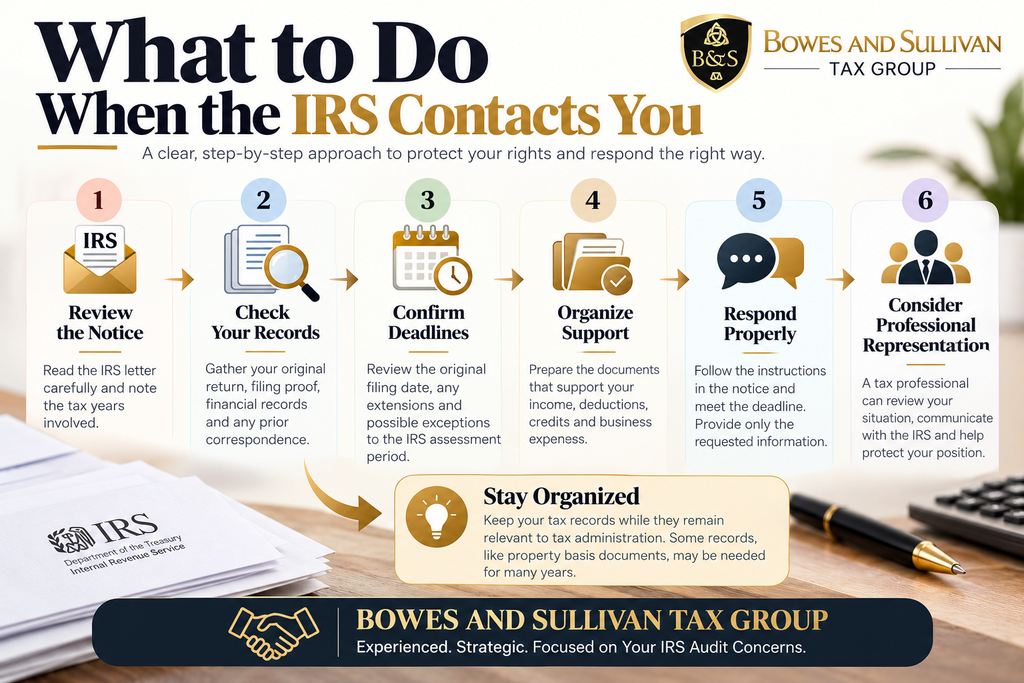
Before responding to the IRS, review the following:
- The original return and proof of filing.
- Any filing extensions or signed assessment extension agreements.
- Income statements, bank records, and business books.
- IRS notices, transcripts, and prior assessments.
- Any amended returns or foreign financial reporting issues.
How Long To Keep Your Returns And Records
If you are asking how long to keep tax records, the IRS recommends retaining supporting documents while they remain relevant to tax administration, generally until the applicable limitation period expires. Property records need special care because you may need them to calculate gain when you sell an asset.
Keep at least these records:
- Federal tax returns and filing confirmations.
- W-2s, 1099s, bank statements, and income records.
- Receipts supporting deductions and credits.
- Business expense records and accounting reports.
- Purchase documents showing property cost and basis.
The general three-year period is not a universal retention deadline. Keep records longer when an exception applies, or a transaction affects a later tax year.
How Bowes & Sullivan’s Audit Representation Helps if the IRS Contacts You
Bowes and Sullivan Tax Group provides IRS audit representation for individuals and businesses nationwide. Our team includes a former IRS agent, Certified Tax Resolution Specialists, tax attorneys, and CPAs, with the firm reporting more than 150 years of combined experience.
We help you address assessment deadlines and IRS audit requests through a focused review of your tax history. Our work includes:
- Deadline review: We examine filing dates, IRS transcripts, and possible exceptions to the assessment statute.
- Audit preparation: We review the return and identify items that need supporting evidence.
- Document organization: We prepare relevant financial records for the IRS examiner.
- Direct representation: We handle IRS communications and help you respond to examination requests.
- Unfiled return assistance: We review missing tax years and help address outstanding filing requirements.
When the IRS contacts you, we assess the notice and the tax years involved before recommending next steps. Our goal is to protect your position and challenge unsupported adjustments. Book a consultation and discuss your IRS audit concerns.
Conclusion
The IRS generally has three years to assess additional tax, but substantial income omissions can extend that period to six years. Failure to file a valid return or filing a fraudulent return can remove the usual deadline. The 6-year audit rule and unlimited assessment exceptions make filing history and accurate income reporting essential when reviewing older tax years.
Before assuming the IRS has lost its authority to assess tax, confirm the original filing date, applicable exceptions, and any valid extensions. Bowes and Sullivan Tax Group can review your records, assess the deadline, and represent you during an IRS examination.
FAQs
Yes. How far back the IRS can audit depends on exceptions, including substantial income omissions, fraud, and valid extensions. Certain cases remain open beyond three years.
The IRS can generally assess tax at any time for a required return you never validly filed. The IRS statute of limitations for unfiled tax returns does not begin under the standard rule until a valid return is filed.
Yes, an extension generally changes the filing deadline used to calculate the standard assessment period. A separate written agreement can extend the assessment period itself.
Keep supporting records until the applicable limitation period expires. If you are deciding how long to keep tax records, retain property basis records longer when later sales or transactions depend on them.
Whether amending a tax return can trigger an IRS audit depends on the facts; an amendment does not automatically trigger an audit. Generally, it does not restart the original assessment period, subject to specific exceptions.
How long the IRS audit typically takes depends on the audit’s complexity, the records provided, and whether disputes arise. Respond promptly and keep copies of every submission.